Horse Racing Form and UK Racecard Analysis
 Available in US
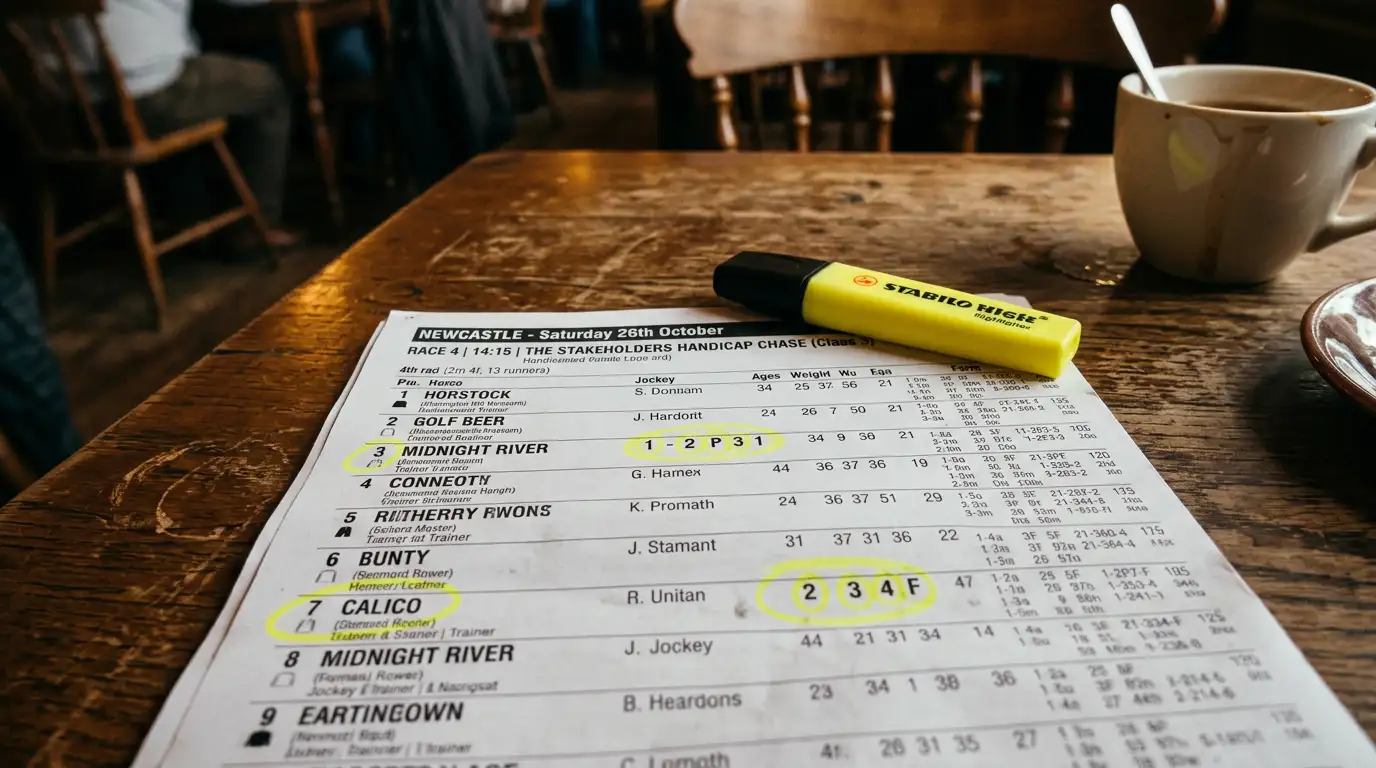
The first time I looked at a racecard properly — really looked at it, not just scanned the horse names — I saw a wall of numbers, letters, and abbreviations that might as well have been Mandarin. 1132-41 (9) next to a horse’s name. C&D on the left margin. OR 87. RPR 92. A jockey’s name followed by “(3)”. Every symbol encodes a piece of information that the market has already priced in. Your job, as someone trying to beat that market, is to decode the same information and then decide whether the market got the price right.
Form is the compressed history of a horse’s racing career: where it ran, how it finished, under what conditions, carrying what weight, ridden by whom. Reading it is not a talent — it is a skill you can learn in a weekend and spend a decade refining. The difference between reading form and reading a tipster column is the difference between doing your own maths homework and copying the answers: one teaches you to think, the other teaches you to follow.
This manual walks through every element of a UK racecard, from the raw form figures to the ratings systems, with the practical focus of someone who reads twenty or thirty cards a week and has done for nine years.
Structural Anatomy of UK Racecards
Pick up any racecard — online or in print — and you will see the same core elements arranged in roughly the same order. Understanding the layout saves time, because once you know where to look, you stop hunting and start interpreting.
At the top: the race conditions. This tells you the class of the race (Class 1 through Class 7, or Group/Listed), the distance, the prize money, the going, and the number of runners. A Class 4 handicap over a mile on good-to-firm ground with fourteen runners is a fundamentally different puzzle from a Group 1 conditions race over six furlongs on heavy ground with five runners. The conditions frame every other piece of data.
Below that, each horse gets a block. The block typically starts with the draw number (flat races) or cloth number, followed by the horse’s name and the form figures from its recent runs. Then the details: age, weight carried (in stones and pounds), the official rating (OR), headgear codes (if any), the trainer’s name and recent form, and the jockey’s name with any claim. Most racecards also display ratings from services like Racing Post Ratings (RPR) and Timeform.
Some of these elements matter more than others depending on the race type. In a handicap, weight and OR are critical because the entire race is structured around them. In a Group race, weight is fixed by age and sex, so class and recent form dominate. In a maiden, there might be no form figures at all for debutants, so trainer reputation and breeding fill the gap. The racecard is a menu. The race conditions tell you which dishes to order.
One piece of the racecard that casual punters overlook: the going allowance. On turf, if the going is officially “good to firm” but the rail has been moved to fresh ground, the effective surface might ride faster than the official description. Knowing where to find this detail — usually in the race header or course notes — can shift your reading of a horse’s ground suitability.
Form Figures Explained
I once sat next to a man at Cheltenham who told me his system was to back every horse whose form figures started with a “1”. He did not understand what the rest of the sequence meant. He had been doing this for three years and was, by his own cheerful admission, well behind. The form figures tell a story, but only if you read the entire sentence.
The standard form string reads right to left, most recent run last. A sequence like 21-3142 means the horse’s last six runs produced finishes of second, first, third, first, fourth, and second — in that order. The hyphen marks the break between racing seasons. Everything to the left of the hyphen happened last season; everything to the right is this season. That distinction is not cosmetic. A horse that finished 1121 last season and has opened this season with 64 is a different proposition from one that has done the reverse.
Certain letters replace or supplement the numbers. “F” means fell, most common in jump racing. “U” means unseated rider — the horse did not fall, but the jockey came off. “P” means pulled up, where the jockey stopped riding, usually because the horse was struggling or injured. “R” means refused, typically at a fence. “B” means brought down — caught up in another horse’s fall. Each of these tells you something different about the horse’s aptitude and soundness. Two “F”s in the last four runs is a red flag for jump bettors. One “P” after a run of decent form often signals a breathing issue or a minor injury that the trainer has since addressed.
“0” appears when a horse finishes outside the first nine. In a sixteen-runner handicap, a “0” might mean tenth, which is not disastrous. In a five-runner conditions race, it means last or near-last, which is. Context converts the symbol into information.
The digit in brackets after the horse’s name — (9), (3), (14) — is the draw in flat racing. Low draws at Chester are gold. High draws at Beverley over five furlongs can be an advantage. I keep a spreadsheet of draw biases by course and distance, updated after every meeting, because the published stats lag behind changes to rail positions and ground conditions. A horse with form figures of 2113 drawn in stall one at Chester is not the same bet as the same horse drawn in stall twelve. The figures tell you what happened; the draw tells you part of what might happen next.
Once you can accurately read the form book, applying this knowledge to a solid handicap race betting strategy becomes much easier.
Weight, Age and Class
A three-year-old carrying 8st 10lb in a Class 3 handicap at Newmarket is operating in a different universe from a seven-year-old carrying 10st 2lb in a Class 5 at Catterick. Understanding why requires you to treat weight, age and class as three sides of one triangle, not three separate topics.
In handicaps, the British Horseracing Authority assigns a rating to every horse, and the handicapper translates that rating into a weight. Higher-rated horses carry more, lower-rated horses carry less. The theory is that this gives every runner an equal chance. The practice is messier. Horses rated at the very top of a handicap band often carry weight that blunts their superiority. Horses rated at the bottom, especially those who have recently dropped in the ratings after a string of poor runs, are carrying less but might be out of form for a reason. The profitable zone sits in the middle — horses rated close to the median for the race, carrying a workable weight, whose recent form suggests the handicapper has not quite caught up with their improvement.
Weight-for-age scales add another layer. In flat racing, younger horses receive a weight allowance when running against older horses because they are still developing physically. A three-year-old meeting a five-year-old over a mile in June carries roughly 9lb less than the older horse. By October, the difference narrows to about 3lb because the younger horse has matured through the season. These scales are fixed and published, but they create exploitable angles. Early-season three-year-olds running against older horses in April get a generous allowance based on the assumption they are still growing. A precocious, well-developed three-year-old trained by a handler known for having them fit early — that horse is getting free weight.
Class determines the quality band of the race. UK flat racing runs from Class 7 at the bottom to Group 1 at the top. A horse dropping from Class 2 to Class 4 is not merely facing weaker opposition; it is facing horses with lower ratings, which reshuffles the weight assignments. The class drop alone is a positive signal, but the size of the drop matters. One class down after a near-miss is a strong angle. Three classes down after a string of tailed-off performances is a horse in freefall, not a horse seeking its level.
Here is a practical shortcut I use: compare the horse’s current official rating to the highest rating it has achieved in the last twelve months. If the gap is more than 7lb and the horse has a plausible excuse for recent poor form — wrong ground, wrong trip, first run after a break — it is potentially well handicapped. If the gap is 7lb or more with no obvious excuse, the horse has genuinely regressed. The racecard gives you the current rating. You need a form database to pull the recent peak, but that thirty-second check has been one of my best filters.
Official Ratings, RPR and Timeform
Three numbers sit on most UK racecards and each one answers a different question. I used to treat them as interchangeable, which cost me money for the better part of a season before I sorted out what each was actually measuring.
The Official Rating (OR) comes from the BHA handicapper. It determines how much weight a horse carries in handicaps and whether it qualifies for certain races. The handicapper updates it after each run, though the adjustment might not appear for several days. OR is a backward-looking assessment of ability relative to the handicap system. It is useful, but it lags. A horse that has improved since its last run — because of a wind operation, a change of yard, or simply physical maturation — might have an OR that understates its current ability by five or six points. The market often catches this before the handicapper does, which is why horses who shorten dramatically in the betting despite no obvious public form improvement are worth watching.
Racing Post Ratings (RPR) are assigned after each race by the Racing Post’s own team of handicappers. They represent how the horse actually performed on the day, adjusted for conditions. The gap between a horse’s RPR and its OR is one of the most revealing numbers on the card. If the RPR from the horse’s last three runs consistently exceeds its current OR by three or more points, that horse is arguably ahead of its mark. If the RPR consistently falls below the OR, the horse has been underperforming relative to the handicapper’s assessment.
Timeform ratings operate on a different methodology. They are speed-based, factoring in sectional times, race pace, and course measurements to produce a figure that represents raw performance independent of the handicap system. Timeform figures are expressed on a scale where the average top-class flat horse rates around 130 and the average Class 5 handicapper sits around 70. The advantage of Timeform is its consistency across courses and conditions. The disadvantage is the subscription cost and the learning curve — you need to understand their pace annotations and condition flags to use the numbers properly.
My approach is layered. I check the OR to understand the weight context. I check the RPR trend over the last three runs to see if the horse is improving or declining. And I use Timeform figures when I want to compare horses that have been racing at different courses or on different ground — because the Timeform number strips out many of the variables that make direct form comparison unreliable. If all three ratings tell the same story, I trust the signal. If they diverge — say, a horse with a low OR, rising RPRs, and a strong Timeform — that divergence is the edge I want to investigate.
Trainer and Jockey Stats on the Racecard
Last spring I backed a well-handicapped horse at Wetherby with solid recent form, the right ground, and a price that screamed value. It finished fourth, beaten three lengths, ridden by an apprentice having his second ride over hurdles. The jockey booking was the one thing I did not check. That mistake taught me a lesson I have not repeated.
Trainer form on the racecard typically shows recent runners, wins, and the percentage strike rate over a rolling period — often 14 days or the current month. A trainer sending out runners at a 25% strike rate over the last fortnight is doing something right: the horses are fit, the yard is in form, and the entries are being aimed at the right races. A trainer at 3% is either struggling with a virus, running horses for education rather than winning, or has a string that has peaked for the season. The number alone does not explain why, but it tells you to ask the question.
Course-specific trainer data is more useful than aggregate form. Certain trainers dominate certain tracks. If you bet regularly at specific UK courses, you will notice patterns that the national stats obscure — a Middleham trainer whose horses consistently outperform at Catterick, a Lambourn yard that raids Chelmsford on quiet midweek cards with a 30% strike rate. These patterns persist for years because they reflect genuine logistical advantages: proximity, familiarity with the track, relationships with course management about ground preparation.
Jockey stats matter differently depending on the quality of the race. In Group races, the top jockeys ride almost everything, so the booking tells you less. In a Class 4 handicap at Pontefract, the jockey choice tells you a lot. A leading jockey who could ride any horse in the race choosing one particular mount is a signal. An apprentice claiming 5lb on a horse near the top of the weights can transform the handicap — but only if the apprentice is competent enough to use the weight advantage rather than waste it through inexperience. Strike rates for apprentices at specific courses, filtered by race class, will tell you which young riders handle pressure and which do not.
The number in brackets after a jockey’s name — “(3)” or “(5)” — is the weight claim, available only to apprentices on the flat or conditional jockeys over jumps. A 5lb claim on a horse rated 85 in a handicap effectively gives that horse a 5lb pull over every non-claiming jockey in the field. That is a significant advantage, worth roughly two and a half lengths in most conditions. I factor the claim into my assessment of every handicap and treat it as a genuine weight reduction, not a novelty.
Course and Distance Record
“C&D” next to a horse’s name on the racecard means it has won at this course and over this distance before. Two letters, enormous implications. But the signal is only as good as the context around it.
UK racecourses vary wildly in character. Epsom has a left-handed, undulating track with a severe camber on the home turn that catches out horses used to flat, galloping courses. Chester is a tight left-handed oval barely a mile round, where low draws and the ability to handle sharp bends matter more than raw speed. Ascot’s straight mile is a test of stamina in the final furlong because of the rising ground. A horse with a C&D record at Chester has demonstrated it handles the idiosyncrasies — the tight turns, the camber, the need to be handy from the start. That same horse at Newmarket, with its wide, straight, galloping track, might be a completely different proposition. On courses where draw bias is a measurable factor, the stall number can matter as much as the form figures.
Distance suitability is more nuanced than it appears. A horse recorded as a “mile” winner might have won a mile on soft ground where the effective distance rode more like nine furlongs because of the slower pace. The same horse over a mile on quick ground with a strong gallop might find itself short of stamina. I separate distance form by going — a horse’s record over a mile on good-to-firm tells me different things from its record over a mile on heavy. The racecard collapses all these into “C&D” or “D” (distance winner), which is why I treat those letters as a starting point for investigation, not as the answer itself.
Horses that have never raced at a particular course are not automatically at a disadvantage. What matters is whether the course profile matches what the horse needs. If I am looking at a horse debuting at Goodwood — a right-handed, undulating track with a downhill run into the straight — I check whether it has form at other undulating, right-handed tracks like Salisbury or Sandown. The course form does not need to be literal. It needs to be analogous.
For a complete overview of our methodology and data analysis, return to the Betting Strategy for Horse Racing main hub.
Recent Form vs Seasonal Form
Every autumn, around mid-October, I watch the same thing happen in the betting markets. Horses with strong summer flat form start running on softer ground as the season turns, and punters keep backing them based on ratings earned in July on good-to-firm. The form figures look brilliant. The conditions have changed completely. Recent form and seasonal form are not the same thing, and confusing them is one of the most common errors in racecard reading.
Recent form — the last two or three runs — tells you about the horse’s current condition, fitness, and wellbeing. Is it improving, declining, or holding steady? A run of 1-2-3 over the last three outings says this horse is in the zone right now, competing at or near its peak. A run of 7-9-0 says something is wrong, regardless of what happened earlier in the season. Recent form is a health check.
Seasonal form, by contrast, tells you about the horse’s aptitude for the conditions that prevail at a particular time of year. National Hunt horses that thrive on heavy winter ground often show a seasonal pattern: poor runs in October on good ground, improvement through November as the rain arrives, peak performance in December and January. Flat horses can show the opposite — sparkling form on fast summer ground, declining returns once the autumn soft arrives. The hyphen in the form figures separates seasons, and smart racecard reading treats it as more than a formatting convention. It marks a change of context.
Here is a technique I use for handicap assessments. I split a horse’s form into two columns: runs on ground described as good-to-firm or faster, and runs on good-to-soft or slower. I look at the average finishing position in each column. If a horse averages third on fast ground and eighth on soft, it is a ground-dependent animal and I adjust my assessment based on the forecast for race day. If it performs consistently regardless of ground, that is a horse whose ability transcends conditions — and those horses tend to be underpriced on days when the ground changes late and the market panics.
Freshness matters too. A horse returning from a break of sixty days or more is an unknown quantity regardless of what its previous form figures show. Some trainers have excellent records with fresh horses — they school them at home, keep them fit, and target specific races on return. Others need a run to bring their horses to fitness. The racecard shows you the gap between runs. Your form database or a simple calendar check tells you whether the trainer uses that gap productively.
Worked Example: Reading a Handicap Card From Scratch
Let me walk through exactly how I read a card, using a fictional but realistic Class 4 handicap over a mile at York, twelve runners, good-to-firm ground.
I start at the top: race conditions. Class 4 means ratings roughly between 60 and 85. A mile at York is a straight, galloping test with no draw bias to speak of on good ground. Good-to-firm suits horses with speed rather than stamina. Twelve runners means a competitive field where the market will be spread and value is more likely to exist.
Next, I scan every runner’s form figures and immediately sort them into three mental piles: horses with recent winning form (at least one “1” in the last four runs), horses with placed form (2s and 3s), and the rest. The first pile gets my full attention. The second pile gets a closer look if the numbers around the places suggest improvement or excuses. The third pile I set aside unless something specific catches my eye — a returning horse after a long break, a first-time visor, a dramatic class drop.
For each horse in the first pile, I run through the checklist. Does it have form on today’s ground? York form or form at a similarly configured galloping track? Is it at the right trip — not just “has it won over a mile” but “has it won over a mile on fast ground at a flat, galloping track”? What is the OR relative to its recent RPR? Is the trainer in form? Is the jockey a positive booking or a concern?
Suppose one horse has form of 31-2142, an OR of 78, RPRs of 81, 79, and 83 over its last three runs, a C&D record, and a leading jockey booked. The OR of 78 against RPRs averaging 81 tells me the handicapper has this horse about 3lb below its current form. That is a well-handicapped horse. The C&D record confirms it handles York. The jockey confirms the trainer is trying. This is my prime selection.
Now I check the price. If this horse is 3/1 (4.0 decimal), the implied probability is 25%. My own assessment, based on the form reading, has it at roughly 30-35%. That is a gap worth betting into. If it is 6/4 (2.5), the implied probability is 40% — which overshoots my own assessment and makes it a pass, no matter how strong the form looks. The racecard identifies the selection. The price determines whether you act on it. A thorough approach to finding value bets depends on this separation between selection and staking.
Building Your Own Racecard Reading Routine
Every racecard reader develops a personal workflow. Mine starts the evening before, scanning entries for the following day and flagging races where the conditions suit my knowledge base — flat handicaps between six furlongs and a mile and a quarter on turf. Morning of the race, I pull up the full card, run through form figures, check ratings, note trainer and jockey data, and assess draw and ground. The whole process takes fifteen to twenty minutes per race. On a six-race card, that is ninety minutes to two hours of preparation before a single bet is placed.
That might sound like a lot. It is a lot. But every minute spent reading a racecard properly is a minute not spent guessing, not spent following tips, and not spent regretting a lazy selection. The racecard is the most information-dense document in UK betting. It compresses a horse’s entire competitive history into a single block of text and numbers. Your job is to decompress it, filter it through today’s conditions, and decide whether the market has made a mistake. When it has, you bet. When it has not, you watch. That distinction is the entire game.
What do the letters in form figures mean?
The most common letters are F (fell), U (unseated rider), P (pulled up), R (refused), B (brought down), and 0 (finished outside the first nine). Each indicates how a horse’s run ended and provides clues about its jumping ability, soundness, or willingness to race.
How do I compare horses that have raced at different courses?
Use speed ratings like Timeform or RPR rather than raw finishing positions. These ratings adjust for course configuration, going conditions, and race pace, giving you a comparable figure across different tracks.
Should I trust official ratings or private ratings more?
Neither is universally better. Official ratings determine handicap weights and reflect the BHA handicapper’s assessment. Private ratings like RPR and Timeform use different methodologies. Comparing all three reveals when a horse is potentially ahead of its official mark.
How many recent runs should I consider when reading form?
Three to five recent runs typically give you enough data to assess current condition without being distorted by older, less relevant performances. Weight the most recent run most heavily, but look at the trend across the sequence rather than any single result.
Published by the Betting Strategy for Horse Racing team.