
Handicap Race Betting Strategy
 Available in US
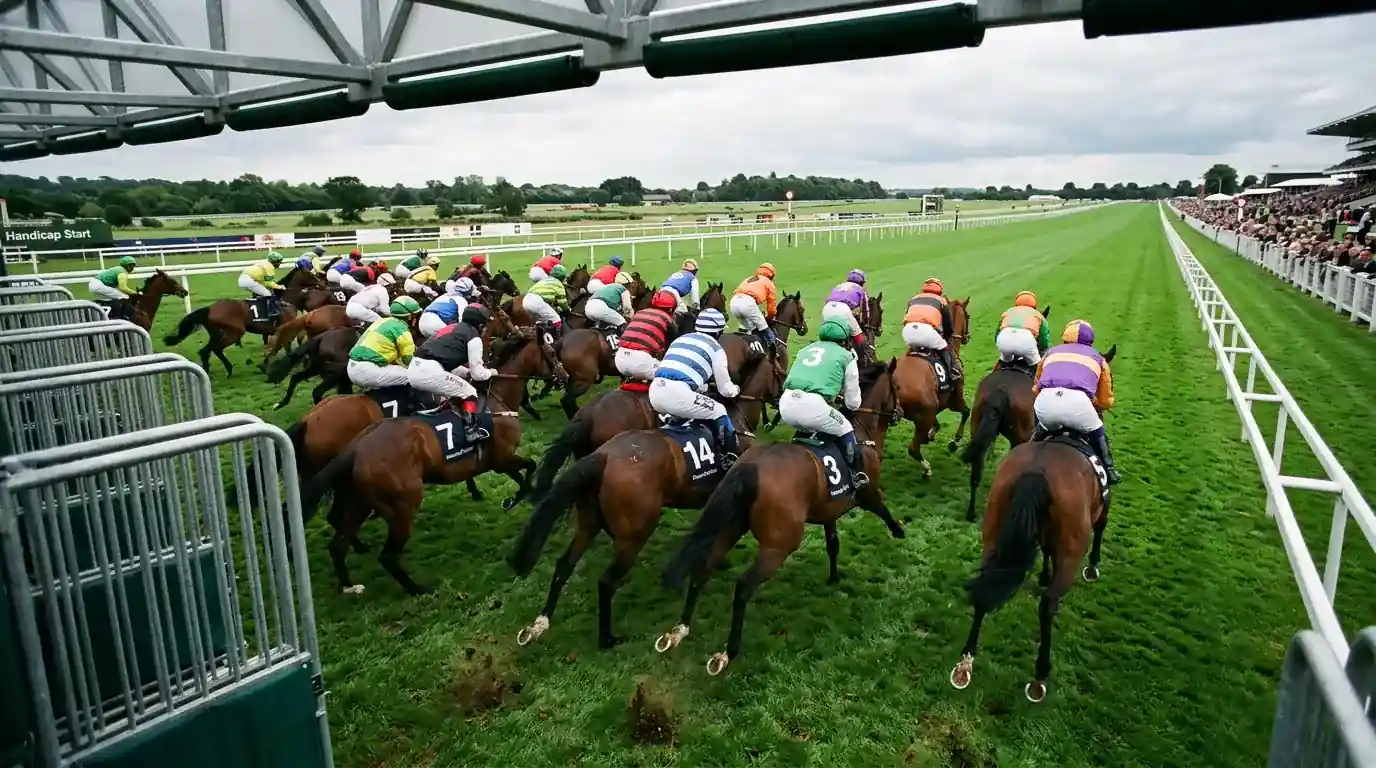
Most UK racing is handicap racing. That single sentence shapes everything about how a competent punter should approach the sport, because the moment you understand it, the question stops being “which horse is best” and becomes “which horse has been underestimated by the official handicapper”. Those are entirely different questions, and the second one is the one that matters.
I’ll go further. The whole infrastructure of UK racing — the handicappers, the ratings, the weight assignments, the ten thousand-plus races run on three hundred and sixty-two days a year — is built to make handicap races as close to fair as humanly possible. The handicapper’s job is to assign weights so that every horse has a roughly equal chance of winning. When they succeed, the race becomes unpredictable. When they fail, the failures are where punter profit lives.
Mechanics of UK Handicap Races
A few years back I watched a friend lose his mind explaining handicaps to his brother-in-law over a Saturday pint. The brother-in-law kept saying “but if the weights make them all equal, why does anyone win?” My friend’s answer — eventually delivered with significant volume — was that the weights aim to make horses equal at the moment the handicapper sets them, but horses change. Some improve, some regress, some run on different ground than their rating was built on. The static rating cannot keep pace with the moving target of actual form.
Every horse with enough qualifying runs is assigned an Official Rating, set by the British Horseracing Authority’s handicapping team. The rating expresses how good the handicapper thinks the horse is, on a scale where one pound of weight is treated as roughly equivalent to one length of margin at the finish. When a horse runs in a handicap race, it carries weight calculated from its rating relative to the rest of the field. The top-rated horse usually carries the most weight; the lowest-rated horse carries the least, often with a substantial gap.
The handicapper updates ratings after every run. A horse that wins by five lengths goes up. A horse that runs badly might come down. The lag between a horse’s actual current ability and its published rating is where every handicap punter is operating. If you can identify horses whose true ability exceeds their official rating — horses that are, in racing parlance, “well handicapped” — you have a structural angle.
What “well handicapped” really means
The phrase gets used loosely, so let me sharpen it. A well-handicapped horse is one whose recent form suggests it can run to a higher rating than the one it’s currently carrying. The most common case is a horse returning from a layoff or a switch in trainer, where the handicapper hasn’t yet had a current run to react to. The second case is a horse that ran better than its finishing position suggested — squeezed for room, hampered, missing the break — where the published result understates what the horse actually did.
Trainers know this game intimately. The phrase “running into a handicap mark” describes the deliberate pattern of running a horse in races where it isn’t expected to win, allowing the handicapper to drop its rating, before targeting a specific handicap where the now-favourable mark gives it a winning chance. This isn’t sinister — it’s part of the architecture of the sport. The handicapper sets the rating, the trainer responds to the rating, and a serious punter reads both moves.
Practically, the signals to look for are these. A horse that has been gradually dropping in the weights through a few uninspiring runs, then arrives in a race where the conditions — ground, distance, course — finally suit it. A horse making a long-awaited handicap debut after qualifying runs in non-handicaps. A horse returning to form from a wind operation, a change of yard, or a deliberate freshen-up. These patterns repeat across the racing calendar, and the punters who recognise them are the ones quietly profiting from handicap racing in a market that loses, on average, to overround and variance.
Pure favourite-backing in handicaps is a losing strategy. In handicap races, favourites win only around 25.7% of the time — meaning they lose roughly three-quarters of the races they’re supposed to win. That’s the gap a handicap punter is trying to exploit: not by backing the favourite, but by spotting the better-priced runner whose mark hasn’t yet caught up with its true level.
The mechanics of the rating itself
It’s worth understanding what an Official Rating actually represents, because the number on the racecard hides several rounds of judgement. The rating is the handicapper’s best assessment of the horse’s ability expressed as a notional weight in pounds. A horse rated 80 is considered, on the scales the handicapper uses, to be 80 pounds better than a horse rated 0 over a particular distance — an enormous gap, since 80 pounds of weight handicap would represent something like sixty lengths.
In a handicap race, weights are set so the top-rated horse carries the maximum (often around 9 stone 12 pounds) and other runners carry weight proportionally less, reduced by one pound per rating point of difference. So a horse rated 75 in the same race as a horse rated 80 will carry five pounds less weight. The handicapper’s bet is that those five pounds will neutralise the five-point gap in ability. If the gap is more than five points in reality, the lower-rated horse should win. If the gap is less, the higher-rated horse should win.
Two layers of error sit on top of this. The handicapper might have the wrong rating for a horse. And the conversion of rating gap into weight might not map cleanly onto the conditions of the day. Both layers create opportunity. Both layers also create the variance that makes handicap racing perpetually unpredictable.
Weight impact across different distances
The “one pound equals one length” formula is a simplification. It works reasonably well at typical UK distances — six furlongs to a mile and a half on the flat — but breaks down at the extremes. Over short sprints, weight matters less than positioning, draw and pace. Over longer distances, particularly three miles or more, weight matters more because the horse carries it for longer.
The practical rule I use: at sprint distances, treat the weight handicap as a soft suggestion that’s easily overcome by pace bias or draw advantage. At middle distances, treat it as a meaningful but not dominant factor. At staying distances, particularly over jumps where weight is carried over fences as well as flat ground, treat it as a major factor in race outcomes. A 7-pound concession over three miles is materially more valuable than the same concession over six furlongs.
For National Hunt handicaps specifically, the weight-to-distance interaction is even sharper because jumping efficiency degrades when a horse is asked to carry more weight, particularly over fences. Trainers know this and aim horses accordingly. Bottom-weight chasers in long-distance handicaps win more than the flat-racing equivalent rate, partly because the weight concession at three or four miles compounds the further the race goes.
This interaction is part of what makes form reading so important — and reading the racecard correctly is foundational. I cover the surrounding skill in my guide to reading horse racing form, which gets into the racecard layout, the form figures, and the ratings systems beyond the Official Rating.
A worked card example
Take a hypothetical sixteen-runner Class 3 handicap over a mile and a quarter on good ground at Doncaster on a Saturday. The top-weight is rated 95 and carries 9 stone 12 pounds. The bottom-weight is rated 65 and carries 7 stone 10 pounds. There’s a 30-pound rating gap and a corresponding 30-pound weight gap, working out roughly correctly on the standard conversion.
Looking at the card, I notice a horse rated 78 making its third run after a six-month break. Its first two runs back have been moderate — finishing eighth and sixth in similar handicaps — but each run was visibly better than the last, and the trainer is on record as expecting the horse to come on for them. The horse is on a falling rating, currently 78 down from its peak of 84 in the previous season. Today it’s carrying 8 stone 7 pounds and is available at 14/1.
The case for backing it isn’t that I think it will definitely win. It’s that the rating has been dropping while the horse has been improving, the trainer has signalled this race as a target, the ground is the horse’s favoured surface, and the weight it carries reflects an outdated assessment of its ability. At 14/1, the price more than compensates for the uncertainty. In handicap races, where favourites win only around a quarter of the time, the higher-priced runners are where positive expectation tends to live for punters willing to do the work.
This is the rhythm of handicap analysis. Most cards have one or two horses where the case for an overlay is plausible. Most days, you back nothing because nothing meets the threshold. The discipline is in the waiting, not in the picking.
What handicap racing rewards over time
Handicap racing rewards patience, pattern recognition, and a willingness to ignore the crowd. Favourites lose three-quarters of these races for a reason: the handicapper is doing their job, the field is competitive by design, and the public’s habit of backing the obvious is structurally unrewarding in this format. Profitable handicap punting starts from the assumption that the favourite is the wrong bet and works backwards from there.
The other reward is volume. With more than ten thousand races a year across the UK calendar, the supply of handicap opportunities is enormous. You don’t need to be right often. You need to be selective, identify the specific patterns where rating lag matters, and stake confidently when the pattern appears. Done well over a few years, handicap-focused punting is one of the few legitimately profitable approaches available to part-time bettors in UK racing. Done badly, it’s a slow, expensive lesson in why most punters lose.
How does a horse become ‘well handicapped’?
Most commonly through a falling rating that hasn’t caught up with current form. A horse might be deliberately campaigned in races where it isn’t expected to win, allowing the official rating to drop, before being targeted at a specific handicap where the mark now suits. Other paths include returning from a layoff before the handicapper has reacted to renewed form, recovering from a wind operation or yard switch, or having recent runs that finished better than the published positions suggested.
How much weight is one length worth at different distances?
The standard handicapping convention treats one pound of weight as roughly one length of finishing margin, but this breaks down at the extremes. Over five and six furlong sprints, weight matters less than pace, draw and positioning. Over middle distances of a mile to a mile and a half it tracks the convention reasonably well. Over staying distances of two miles or more, particularly over jumps, weight matters more because horses carry it for longer and jumping efficiency suffers under heavier loads.
Why do favourites lose more often in handicap races?
Because handicaps are designed to neutralise quality differences through weight. The favourite is usually the highest-rated horse in the race carrying a correspondingly bigger burden, while lower-rated runners are dropped into a weight that should — if the handicapper is right — make them competitive. In UK handicap racing favourites win only around 25.7% of the time, well below the rate in non-handicap races, because the weight structure deliberately works against them.
Prepared by the Betting Strategy for Horse Racing editorial staff.