Value Betting Systems and True Odds
 Available in US
- Identifying Profitable Value Bets
- The Implied Probability Formula You Need to Internalise
- Calculating True Odds From Your Own Assessment
- Where Value Hides in UK Racing
- Worked Example: Finding Value in a Saturday Handicap
- Tracking Value Over Time
- Common Value Traps That Drain Bankrolls
- Where Value Betting Takes You Next
I backed a 6/1 shot at Newbury three years ago — a horse with a dodgy draw, a trainer out of form, and a jockey claiming seven pounds. Every tipster column ignored it. But I had spent forty minutes building my own tissue prices for that race, and my numbers said this horse was closer to a 3/1 chance. It won by two lengths. That single bet did not make me rich. What it did was prove, for the hundredth time, that the gap between a bookmaker’s price and reality is where the money lives.
Value betting is the discipline of identifying that gap — systematically, race after race, card after card. It is not about picking winners. A horse can win at 1/5 and still represent terrible value if its true probability of winning is higher than the price implies. Conversely, a 12/1 loser can be a perfect value bet if the real chance was closer to 8/1. An academic study analysing more than six million races found that blind favourite backing loses at roughly 5.5% on turnover, while lumping on longshots at odds between 4.0 and 16.0 bleeds money at an 18% clip. The difference is not luck — it is the market systematically mispricing horses at both ends of the spectrum.
This guide strips value betting down to its moving parts: the formulas, the practical shortcuts, the traps that catch even experienced punters. If you have been betting on gut feel and wondering why the bankroll drifts sideways, the reason is almost certainly here.
Identifying Profitable Value Bets
Most people who bet on racing think in terms of outcomes. “Will this horse win?” That is the wrong question. The right question is: “Does this price overstate or understate the real chance of this horse winning?” The answer separates value bettors from everyone else at the track.
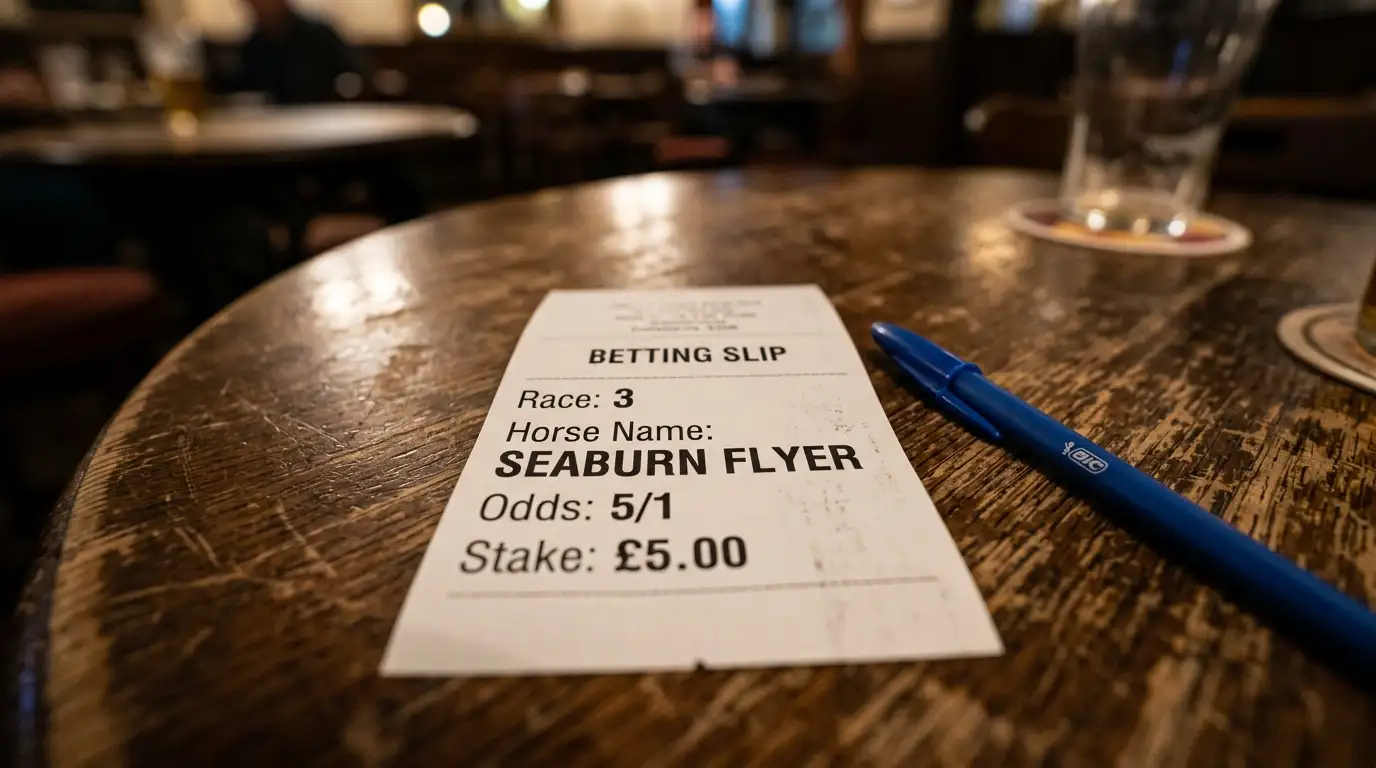
A value bet exists whenever the odds offered by a bookmaker are higher than the actual probability of the outcome occurring. Suppose you estimate a horse has a 25% chance of winning a race. In a fair market with no margin, that equates to odds of 3/1 in fractional terms, or 4.0 decimal. If a bookmaker is offering 5/1 — decimal 6.0 — on that same horse, you have found value. The price implies the horse has roughly a 17% chance, but your assessment says 25%. That eight-percentage-point gap is your edge.
It works the other way too. A horse you rate at 50% might be priced at 4/5, implying a 56% chance. That is negative value — you are paying more than the ticket is worth. Over one race it might not matter. Over a thousand, it bleeds you dry. The entire concept rests on one brutal truth: the market does not need to be wrong often for a disciplined bettor to profit. It only needs to be wrong enough, on enough occasions, for your strike rate at those prices to compound into a positive return on investment.
I like to think of it as a supermarket analogy. If a tin of beans is worth 80p to you and the shop charges 60p, you buy. If the shop charges a pound, you walk past. Value betting is exactly this — buying horse racing outcomes only when the price is below your assessed worth. The discipline is in doing the assessment honestly, not in “knowing” which horse wins.
The Implied Probability Formula You Need to Internalise
Before I could find value in anything, I had to learn to read what the bookmaker was actually telling me. Every set of odds encodes a probability. Strip out the margin, and you see what the layer really thinks about each runner’s chance. The formula is simple enough to do on the back of a beer mat.
For decimal odds: Implied Probability = 1 / Decimal Odds x 100.
A horse at 4.0 decimal? Implied probability is 1 / 4.0 = 0.25, or 25%. A horse at 2.5? That is 1 / 2.5 = 0.40, so 40%. For fractional odds, the calculation adjusts slightly: Implied Probability = Denominator / (Numerator + Denominator) x 100. So a horse at 5/2 gives you 2 / (5 + 2) = 0.2857, which is 28.6%.
Here is where the bookmaker’s game becomes transparent. Add up the implied probabilities for every runner in a race, and the total will exceed 100%. In a typical UK race, the sum lands somewhere between 105% and 120%, depending on field size and how competitive the book is. That excess is the overround — the bookmaker’s built-in margin. On a race where the overround is 115%, you are collectively paying 15% more than a “fair” market would charge. The mechanics of overround and how prices get set have a direct impact on where value appears and how much of it is available.
Why does this matter for value bettors? Because implied probability is the benchmark against which you measure your own assessment. If the market says a horse is a 20% chance (5.0 decimal) and you have it at 28%, the discrepancy is your potential edge. But you need to account for the margin baked into that 20%. On an exchange, where the overround can sit as low as 101-102%, the implied probabilities are much closer to reality, which means finding genuine value is harder — but the prices you do find tend to be cleaner.
I run these numbers for every race I consider betting. It takes about ninety seconds per race once you are used to it. The ones I skip are the ones where my own assessment lands within a percentage point or two of the market — no edge, no bet. The ones that excite me are the races where my figure and the market’s figure are five or more points apart. Those are worth a proper look.
Calculating True Odds From Your Own Assessment
This is where the hard graft starts, and where most guides on value betting conveniently stop. Knowing the formula is one thing. Producing your own probability estimate for a twelve-runner handicap at Haydock on a Tuesday afternoon — that is another thing entirely. There is no single correct method, but there are frameworks that keep you honest.
The approach I have used for nine years is tissue pricing. Before looking at the bookmaker odds, I go through the card and assign each horse a percentage chance based on form, conditions, class, and any other factor I consider relevant. The percentages must total 100%. If I have twelve runners and my numbers add up to 94% or 108%, I have made an error somewhere and I go back.
Start with what the data tells you about base rates. Favourites in UK racing win around 30-35% of the time across all race types. Second favourites convert at roughly 18-21%. By the time you reach the third in the market, the strike rate drops to 12-15%. These are long-run averages that shift depending on the type of race. Odds-on favourites in flat racing win between 55% and 60% of their starts. In maiden races, that figure climbs to 61%. In handicaps, where the weights are designed to level the field, the market leader wins only about 25.7% of the time — losing nearly three out of every four starts.
These base rates are the skeleton. Now you add the muscle. A horse that has won twice at the course and distance, on today’s going, with a trainer in strong 14-day form and a jockey who rides this track well — that horse’s probability should be adjusted upward from whatever the base rate suggests for its market position. Conversely, a horse switching from a flat surface to heavy ground for the first time, with a trainer whose yard has produced one winner from its last thirty runners, deserves a downward adjustment.
Be specific. “I think this horse has a 30% chance” is not enough. Ask yourself: if this exact race were run one hundred times under these conditions, how many times would this horse cross the line first? Thirty times? Twenty-two? Forty? Your answer is your tissue price. Convert it to odds (1 / probability in decimal), compare it to the market, and you have your value reading.
A practical shortcut I use for handicaps is to start by giving the favourite a probability based on the handicap base rate — around 26% — and then adjusting up or down by two to five percentage points depending on specific factors. Every point I add to one horse, I take from another. It forces intellectual honesty: you cannot like every horse in the race.
Where Value Hides in UK Racing
Not all races are created equal when it comes to value. I learned this the expensive way, spending two years trying to beat five-runner novice hurdles where the market had the favourite right 60% of the time and the prices on everything else were tissue-thin. The edges in those races are tiny and infrequent. You are better off looking where the bookmaker’s job is hardest.
Handicaps are the natural habitat of the value bettor. Large fields, compressed abilities, and a handicapper’s rating that might be a pound or two behind a horse’s actual improvement — these create gaps. In handicap races, favourites win just 25.7% of the time, which means the field wins nearly three-quarters of all contests. When the favourite is losing that often, the remaining probability is spread across many runners, and bookmakers cannot price all of them accurately. Someone gets a generous number.
Seasonal transitions are another hunting ground. The first few weeks of the flat turf season, when horses return from winter breaks, produce unreliable form lines. The market prices these runners based on ratings earned six months ago, while trainers know whether a horse has thrived or stagnated over the off-season. If you follow stable reports, gallops chatter, and trainer interviews closely, you can sometimes identify a horse whose winter has gone better than the market assumes. The same applies to the jumps-to-flat switch and vice versa.
Big festival handicaps — the Cheltenham handicap hurdles, the Royal Ascot Heritage Handicaps, the Ebor at York — attract enormous fields and enormous betting volumes. Counterintuitively, this does not make the market more efficient. It makes it noisier. Casual money floods in on names, colours, and newspaper tips, distorting prices for less popular runners. The horse at 20/1 that casual punters ignore might deserve to be 12/1 based on a form reading that accounts for a favourable draw and a switch back to its preferred going.
One last pocket of value that gets overlooked: early-season two-year-old races. Nobody has form data. The market relies on breeding, stable reputation, and whispers. If you have done your homework on sire statistics over specific distances and going types, you can occasionally find a price that dramatically underestimates a debutant. Blind backing of favourites at Betfair Starting Price returns roughly a negative 7% yield across all UK racing. But within specific subsets — underbet handicaps, seasonal openers, debutant maidens — the picture looks very different for a prepared bettor.
Worked Example: Finding Value in a Saturday Handicap
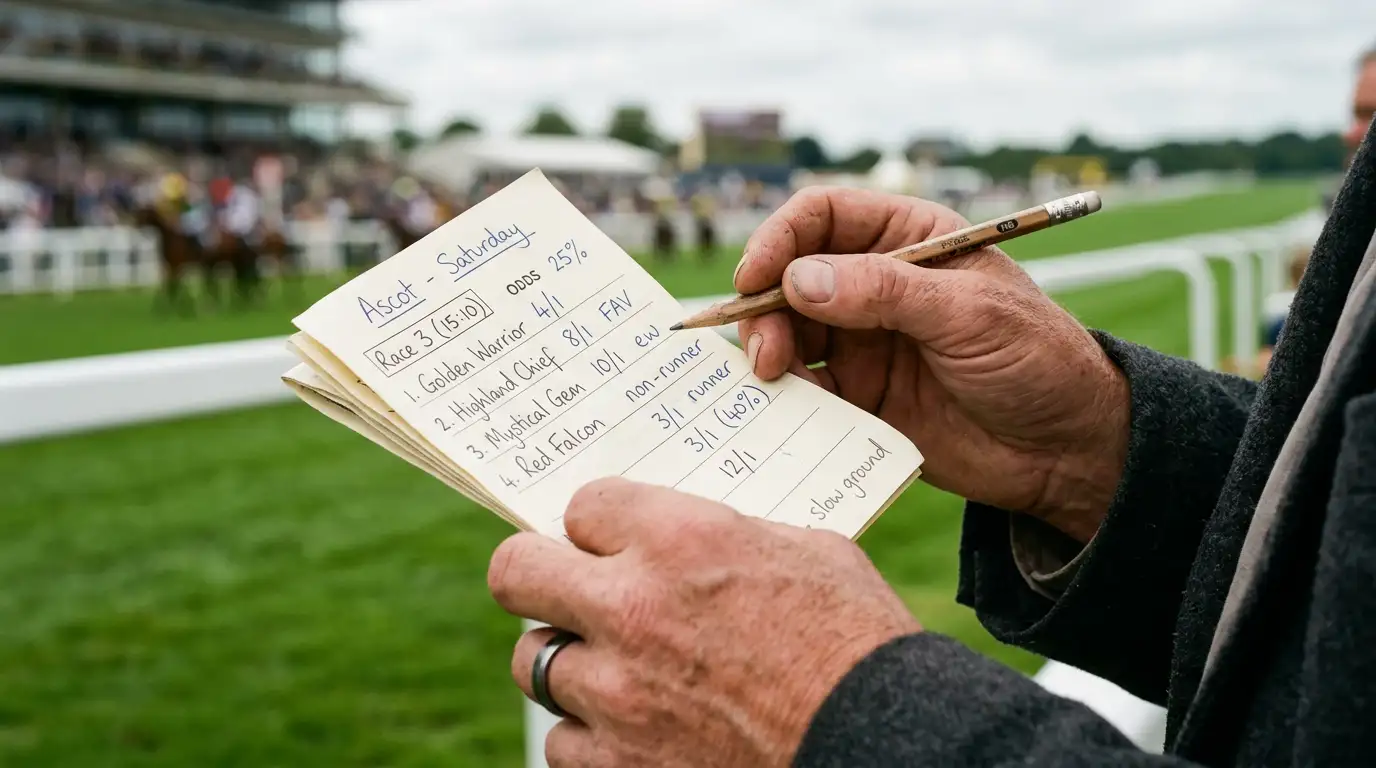
Let me walk through a real decision process, stripped of hindsight. Saturday card, twelve-runner 0-105 handicap on good-to-firm turf over a mile at Newmarket. The favourite is priced at 7/2 (decimal 4.5), implying a 22% chance. I build my tissue.
The favourite has strong recent form — two wins from three starts — but both came on soft ground. Today’s surface is quick. I drop its probability to 18%. The second favourite at 5/1 (17% implied) has course-and-distance form and a trainer with a 23% strike rate in the last fortnight. I rate it at 20%. Already I have found a horse whose probability I rate higher than the market does.
But the real interest is further down the card. An eight-year-old at 14/1 (implied 6.7%) dropped in class for this race, ran well on good-to-firm last time out, and carries the lowest weight in the field. Its trainer operates at a modest 9% overall strike rate, but in handicaps at this course the figure is 17% over the last three seasons. I rate this horse at 12% — nearly double the market’s assessment. My true odds: 1 / 0.12 = 8.33 decimal, or just over 7/1. The market offers 14/1. That is a clear value bet.
The expected value calculation: (0.12 x 14) – (0.88 x 1) = 1.68 – 0.88 = +0.80. For every pound staked, the expected return is 80p profit over the long run — if my probability estimate is accurate. Of course, this horse will lose 88% of the time in equivalent situations. The bet is still correct. Value betting is not about being right on the day. It is about being right on the number.
One more thing I check before committing: the overround on this race. I add up the implied probabilities of all twelve runners from the best available prices. The total is 112%. That is a moderate margin. On an exchange, the same market might total 102%. If I can get 14/1 or better on the exchange with sufficient liquidity, I take that route. If the exchange price has already been taken down to 12/1 by other sharp bettors, the bookmaker’s 14/1 with Best Odds Guaranteed might still be the smarter play.
Tracking Value Over Time
A single value bet proves nothing. I might rate a horse at 25% and the market at 15%, back it at 6/1, and watch it trail in last. Does that mean my assessment was wrong? Not necessarily. The only way to know whether your value identification process works is to track it across hundreds of bets and measure the results.
Every bet I place gets logged with three numbers: the price I took, the implied probability at that price, and my own assessed probability. After a few hundred bets, I compare my cumulative assessed probabilities against actual strike rates. If I have been rating horses at an average of 20% and they are winning 21% of the time, my calibration is strong. If they are winning 14% of the time, I am overestimating quality and need to recalibrate downward.
The minimum sample size before this data becomes meaningful is around 200-300 bets at broadly similar odds ranges. Below that, variance dominates and you cannot distinguish a genuine edge from noise. I spent my first full year value betting with no clear idea whether I was any good at it. The spreadsheet said I was profitable after 400 bets, but the graph was a jagged mess of peaks and troughs that would have sent most people back to following tips in the Racing Post.
Two metrics matter most. Return on investment — your net profit or loss divided by total stakes, expressed as a percentage — tells you the overall efficiency of your betting. Yield — the average profit per bet — tells you the edge per selection. A 5% yield over a thousand bets at level stakes is a strong result for a private punter. Anything above 8% over that sample is exceptional. Anything below zero is a signal to stop, review your tissue-pricing method, and work out where the assessments are drifting.
Log the race type too. You might discover you are excellent at pricing big-field flat handicaps but terrible at small-field National Hunt novice chases. Segmenting by race type is how I found that my edge lives almost entirely in 10+ runner flat handicaps and all but disappears in races with fewer than six runners.
Common Value Traps That Drain Bankrolls
The first time I thought I had cracked value betting, I was backing longshots with abandon. Anything over 10/1 where I could construct even a thin argument for a higher probability felt like free money. It was not. Longshots between 10/1 and 33/1 carry the heaviest favourite-longshot bias in the market — the phenomenon where the further out in price you go, the worse the return per unit staked becomes. Backing horses at that range without a genuinely rigorous probability assessment is how bankrolls evaporate.
The second trap is false precision. You run your tissue pricing, decide a horse is a 14.3% chance, see the bookmaker offering 12%, and call it value. But your estimate is not accurate to one decimal place. It is a rough assessment based on form interpretation, not a laboratory measurement. A realistic error bar on most tissue prices is plus or minus three to five percentage points. If your “14.3%” horse might genuinely be anywhere between 10% and 19%, a price implying 12% is not reliably value — it is within your margin of error. I only bet when the gap between my assessment and the market is wide enough to survive that uncertainty.
Third: recency bias in form reading. A horse wins impressively last time out, and suddenly every value bettor in the country rates it five percentage points higher than the market. But the market has already incorporated that win into the price. The bookmaker saw the same race you did. Value rarely comes from the most obvious data point. It comes from the data points the crowd discounts — a quietly improving speed figure, a subtle equipment change, a first-time visor on a horse whose pedigree suggests it will help.
Fourth, and this one stung me personally: confusing a big field with automatic value. Yes, handicaps with many runners produce more mispricings. But they also produce more randomness. A bad draw, a rough trip, a slow start — these factors can destroy a well-handicapped horse’s race irrespective of its ability. You can be right on the probability and still lose more often than your numbers suggest, because the race-day variables in big fields are noisier than in small ones. The edge is real, but it takes longer to show up.
Finally, the sunk-cost trap. You have spent forty minutes pricing up a race, found a horse you rate at 18% while the market says 10%, and placed the bet. It loses. The next race on the card starts in fifteen minutes. You have not priced it up properly, but you feel the need to “get one back.” This is the exact moment where value betting becomes gambling. If you have not done the work, you do not have a tissue, and without a tissue you have no idea whether any price is value. Walk away. Profitable betting is a marathon, not a sprint — it rewards patience and process, not impulse.
How do I calculate implied probability from horse racing odds?
For decimal odds, divide 1 by the decimal price and multiply by 100. A horse at 5.0 has an implied probability of 20%. For fractional odds, divide the denominator by the sum of numerator and denominator — so 4/1 gives 1 / (4+1) = 20%. Remember that these implied probabilities include the bookmaker’s margin, so the raw figure slightly overstates the true market view of each horse’s chance.
What percentage edge makes a horse racing bet a value bet?
Any positive edge technically qualifies, but in practice I look for at least a five-percentage-point gap between my assessed probability and the market’s implied probability. Smaller gaps fall within the margin of error inherent in tissue pricing. A horse I rate at 25% when the market says 20% is borderline. A horse I rate at 25% when the market says 14% is worth serious attention.
Can I find value bets on short-priced favourites?
Rarely, but it happens. Odds-on favourites on the flat win 55-60% of the time. If you identify a situation where the true probability is higher still — say 70% — and the price implies only 60%, that is value despite the short odds. The returns per bet are small, but the strike rate is high and the variance is low. Most consistent value, though, sits in the 4/1 to 14/1 range where bookmaker margins and public bias create the widest gaps.
How many races should I assess before placing a value bet?
There is no fixed number. Some days I price up eight races and find nothing worth backing. Other days, the first card I look at throws up two strong value plays. The discipline is in not forcing bets. If you are averaging fewer than one value bet per racing day across all UK meetings, your probability assessments are either too conservative or you are not covering enough cards. If you are backing something in every other race, you are almost certainly not being selective enough.
Where Value Betting Takes You Next
Nine years into this, I still get races wrong more often than I get them right. That is not a contradiction — it is the point. Value betting is not a prediction game. It is a pricing game, and the scoreboard is your P&L sheet after a thousand entries, not the result of any single race.
The habits that make it work are boringly simple. Price every race before you look at the bookmaker odds. Log every bet with your assessed probability and the price taken. Review the log monthly and segment by race type, odds range, and track. Cut the areas where your calibration is off. Double down on the areas where your strike rate matches or exceeds your assessments.
What I have not covered here — because it deserves its own treatment — is what happens after you find value. How much you stake on each bet, and how you protect your bankroll from the inevitable losing runs, is a separate discipline entirely. The best tissue-pricing system in the world will destroy you if your staking is reckless. The edge gets you in the door. The staking plan keeps you in the building.
Created by the ”Betting Strategy for Horse Racing” editorial team.