Each-Way Betting Strategy
 Available in US
Most punters I meet treat each-way as a safety blanket — a polite hedge in case their fancy “only places”. That framing has cost the British betting public more money than almost any other habit I can think of. An each-way bet is not a softer version of a win bet. It is two independent transactions stapled together, and the question of whether to use it has nothing to do with caution and everything to do with the place terms a bookmaker has been forced to offer in that particular race.
Once you start looking at each-way as a structural product rather than a comfort blanket, the decision becomes mechanical. Sometimes the win half is the only sensible bet. Sometimes the place half is so generously priced that it carries the entire wager. And occasionally — more often than people realise — the each-way price represents a clean overlay that a straight win punter would walk straight past.
When evaluating each-way terms on outsiders, it is crucial to account for the favourite-longshot bias in UK racing to avoid negative expected value.
Mathematical Construction of Each-Way Bets
I once watched a friend cheer himself hoarse because his 16/1 selection finished fourth in a Saturday handicap, then go quiet when I pointed out that he’d lost his stake anyway. He had backed it each-way at a six-runner race. The bookmaker only paid the first two. He had been operating on a vibe rather than a contract.
That story matters because each-way is a contract, not a tradition. You place two stakes of equal size: one on the horse to win at the full quoted odds, the other on the horse to be placed at a fraction of those odds. The “place” definition depends entirely on the bookmaker’s terms for that race — usually a function of field size and race type. A 16/1 winner in a 12-runner handicap with each-way paying a quarter the odds first four returns 16 units on the win half plus 4 units on the place half. The same horse finishing fourth returns only the place half. The same horse finishing fifth returns nothing.
The mechanics matter because they decouple the two halves. Some races offer terrible win value and excellent place value. Some are the reverse. The whole point of each-way analysis is to look at the two halves separately and ask which one — if either — is profitable to back. Treating them as a package and clicking the box on every bet slip is how punters convert a winning angle into a losing one.
One nuance trips up newcomers more than any other. Your total stake on an each-way bet is double what you typed in. Put a tenner on each-way and twenty pounds leaves your account. I’ve seen people learn this the hard way during a Cheltenham accumulator.
Place terms by field size
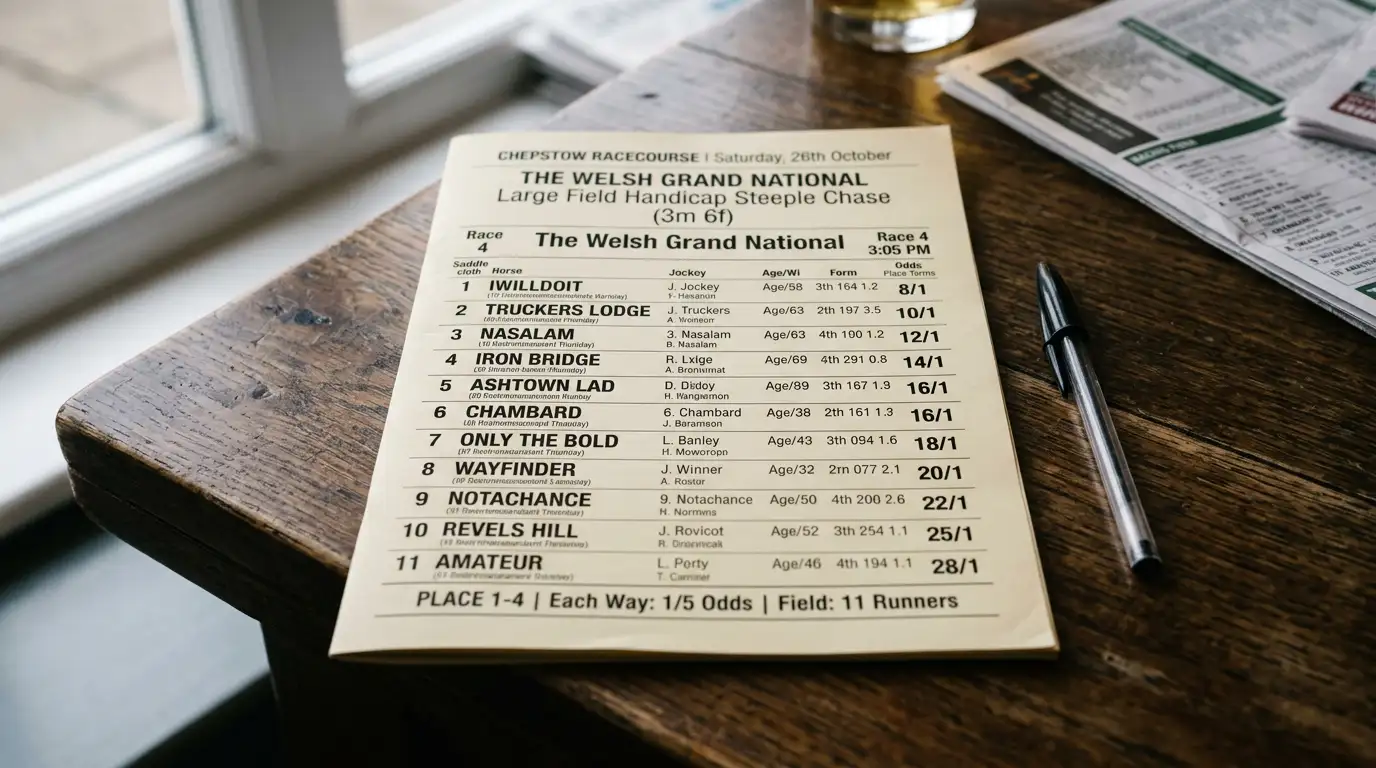
The standard UK place terms are not arbitrary. They come from a long-running compromise between bookmakers’ margins and the punter’s appetite for at-least-something. The framework is roughly this: fewer than five runners is win-only territory, five to seven runners pays one-quarter the odds on the first two, eight or more pays one-fifth on the first three, handicaps of twelve to fifteen runners pay one-quarter on the first three, and handicaps of sixteen-plus pay one-quarter on the first four.
That last band is where the interesting maths starts. A sixteen-runner handicap with quarter-the-odds first four places gives the punter four bites at the place pool, and the fractional payoff is more generous than the eight-runner standard. That single line in the terms is the reason large-field handicaps are the natural home of each-way thinking. The fixture list deliberately produces a lot of them — UK racing puts on more than ten thousand races a year across three hundred and sixty-two days, and a significant share of the Saturday handicap card is built around fields large enough to qualify.
I run through the terms before doing any analysis. If a race has eight runners with one-fifth first three, my mental model is different from a fifteen-runner handicap with one-quarter first three, and different again from a sixteen-runner handicap with one-quarter first four. The same horse at the same price is a different bet depending on which set of terms it falls under.
When each-way carries an edge
The mathematical sweet spot is a horse priced between roughly 8/1 and 20/1 in a field that pays out generously on the place half. The win half might be a fair price or a slight overlay; the place half is where the overlay lives. Bookmakers price the win market carefully and then bolt place terms on top, and the place terms cannot adjust race by race the way win prices can. That gap is what a serious each-way punter is fishing for.
Consider what happens in a sixteen-runner handicap with one-quarter first four when a horse is priced at 12/1. The place half effectively pays 3/1 for any of four positions. If you assess the horse as having a realistic 25% chance of finishing in the first four, the place bet alone is at fair odds; if its real chance is 30% or 35%, you have a meaningful overlay on the place half before the win half has done anything. Long-term data from the betting markets backs this up: the top three in the market account for roughly 65% to 70% of all winners and an even higher share of the place positions, so any horse you fancy at single-figure-to-low-double-figure prices is competing for places against a small group.
The trap is using each-way on short prices. A 5/2 favourite each-way is almost always worse than a straight win bet. The place portion pays a fraction of a short price, the win portion is identical to a straight win, and you have doubled your stake to chase a tiny place return. Each-way on favourites is the bet that beginners place because it feels safe. It is the bet that bookmakers love.
For the deeper question of when large fields favour structured stakes generally, I cover the broader handicap angle in my handicap race strategy article.
Extra-place promotions and what they actually change
Once or twice a week, bookmakers run “extra place” promotions on big Saturday handicaps and festival races. The standard one-quarter first three becomes one-quarter first four, or first five, or in extreme cases first six. These promotions are the single most exploitable each-way concession in the UK market.
The reason is simple. Place terms can only move in one direction when a promotion fires — up. The win price stays the same. So your place half just got materially more valuable while your win half is unchanged. If you were neutral on the bet at the standard terms, the promotion has pushed you onto an overlay automatically. If you were already keen at the standard terms, you’ve just had the value handed to you.
Holding accounts at two or three operators specifically to access these extra-place offers is one of the most consistent edges available to small-stakes punters. Testing and review data across multiple bookmakers shows that using two to three accounts for price and promo comparison routinely improves the realised return by 2% to 5% relative to a single-account punter — and that figure includes punters who never explicitly chase each-way overlays. For someone who hunts the offers deliberately, the gap is wider.
One word of warning. Extra-place offers are sometimes restricted to specific bet types, specific maximum stakes, or “selected horses”. The phrase “selected horses” usually means “the favourite”, which destroys the overlay because you’ve stopped being able to back the rough-priced runners where the offer would actually move the maths. Always read the terms before deciding the promotion changes your selection.
The 80/20 staking variant
You’ll see references in older racing books to the “80/20 method”, which is an each-way variant where you stake more on the place half than the win half. The classical version puts 80% of the total stake on the place portion and 20% on the win. The logic is that the place half hits considerably more often than the win half, so a punter who consistently picks horses at 10/1 to 25/1 with strong place chances can build a steadier bankroll by weighting toward the more frequent outcome.
I’m split on this. The maths is sound for very specific horse profiles — strong stayers in big handicaps who run their race honestly but who are not classy enough to win at the level. For that exact type, the 80/20 split converts variance into steadier returns. But the strategy only beats straight each-way if you have the discipline to apply it only to the right races, and most people who hear about it apply it to everything. As a default it doesn’t beat a normal each-way split. As a niche tool applied to a specific subset, it has its place.
The point I’d press hardest is that 80/20 is not a magic formula. It’s a way of expressing the structural insight that place half is where many large-field handicap edges live. If you already understand that, the staking split becomes a stylistic choice rather than a strategy in itself.
Maximize your returns and refine your approach at the Betting Strategy for Horse Racing official site.
What to take from all of this
Each-way is a structural product. Use it when the place terms — particularly extra-place promotions and one-quarter first four on big handicaps — produce a measurable overlay on the place half. Avoid it on favourites and small fields. Read the terms before you read the form, because the same horse at the same price is a different bet under different place structures. And keep your eye on Saturday morning promotions: those are where the each-way punter still has a meaningful edge over the modern betting market.
If you remember nothing else, remember this: doubling your stake to cover a place is not caution. It is a separate bet that needs its own justification. Treat it that way and each-way becomes a sharp tool. Treat it as a comfort blanket and you’ll lose money politely for years.
When does each-way betting outperform a straight win bet?
When the place terms are unusually generous relative to the horse’s realistic place chance. Sixteen-plus runner handicaps paying one-quarter the odds the first four, and any race running an extra-place promotion, are the structural sweet spots. The sweet-spot price range is roughly 8/1 to 20/1, where the place fraction still pays enough to matter and the horse has a credible shot at hitting the frame.
Are extra-place promotions actually worth chasing?
Yes — they’re one of the few consistent edges left for small-stakes punters. Each extra paid place adds value to the place half of the bet without touching the win price, so a previously neutral bet becomes an overlay automatically. The catch is to read the terms: ‘selected horses’ often means the favourite only, which removes the overlay because rough-priced runners aren’t eligible.
What is the 80/20 rule in each-way betting?
It’s a staking variant that puts 80% of total stake on the place half and 20% on the win half, rather than splitting evenly. The aim is steadier returns for punters who consistently target large-field handicaps where the place chance is much stronger than the win chance. As a default for every bet it doesn’t beat conventional each-way splits, but for the specific profile of a strong-staying handicapper at double-figure odds it can smooth variance meaningfully.
Written by the editors at Betting Strategy for Horse Racing.