Betfair Exchange for Horse Racing: A First-Timer’s Operating Manual
 Available in US
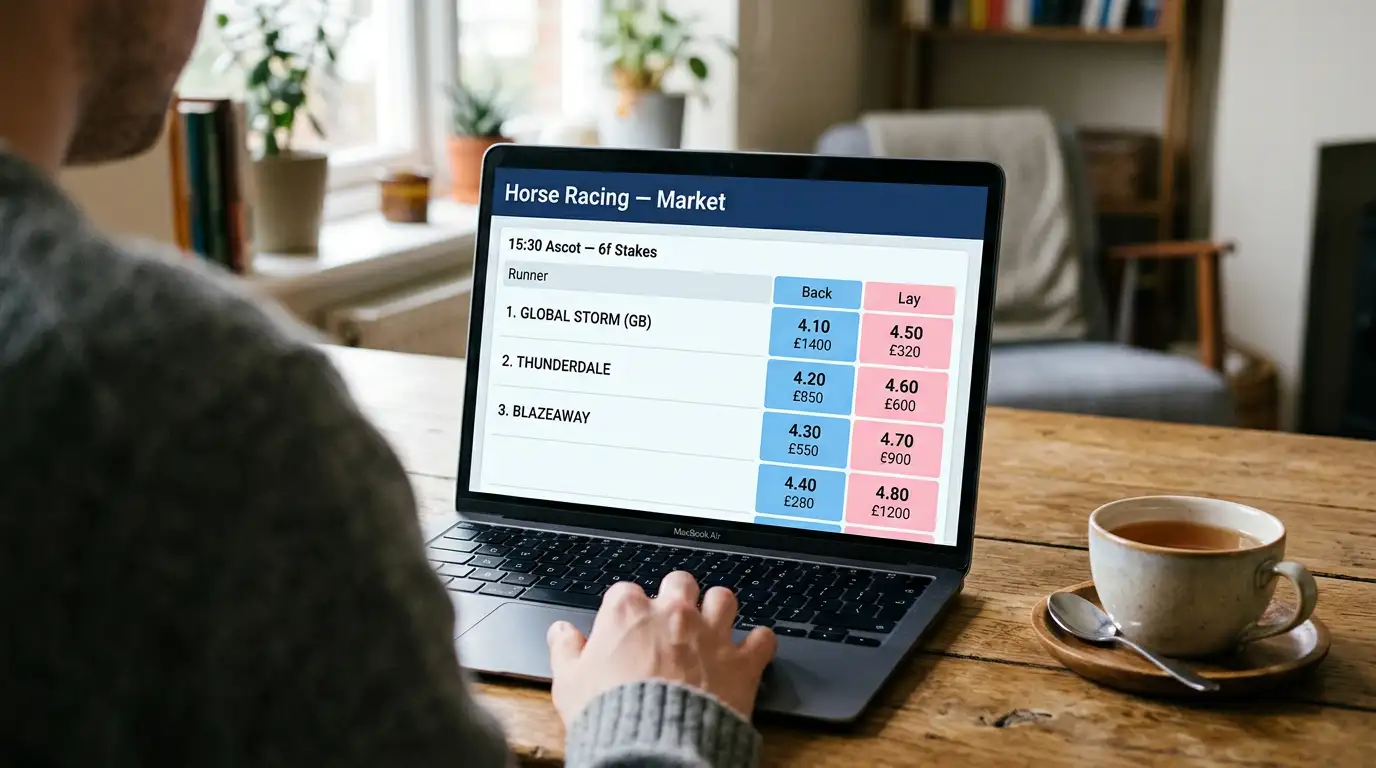
When I first opened a Betfair Exchange account, I lost money for a week before I realised I’d been clicking the wrong column. The interface presents back and lay options side by side, in different shades of blue and pink, and the assumption that the bigger number is the better price isn’t always correct. By the end of that week I’d corrected the habit but I’d also developed a healthy respect for how different the exchange is from the sportsbook many punters grow up with.
A betting exchange isn’t a bookmaker. The exchange operator doesn’t set the prices. They run a marketplace where punters trade directly with other punters, and they collect a commission on net winnings rather than building a margin into the odds. The model produces consistently better prices than sportsbook operators in most situations, gives access to lay betting that sportsbooks don’t offer, and rewards punters who understand how the marketplace operates. The model also has its own quirks — commission calculations, liquidity issues, the slightly disorienting fact that prices can move because someone else clicked a button — that take time to internalise.
How the exchange works in practice
Every market on Betfair Exchange consists of punters offering bets to each other. If I want to back a horse at 5.0, I post a request for that price; someone else willing to take the other side at 5.0 has to match my bet for the transaction to complete. If no one is offering 5.0, my bet sits unmatched until someone arrives at that price or I take whatever’s currently available.
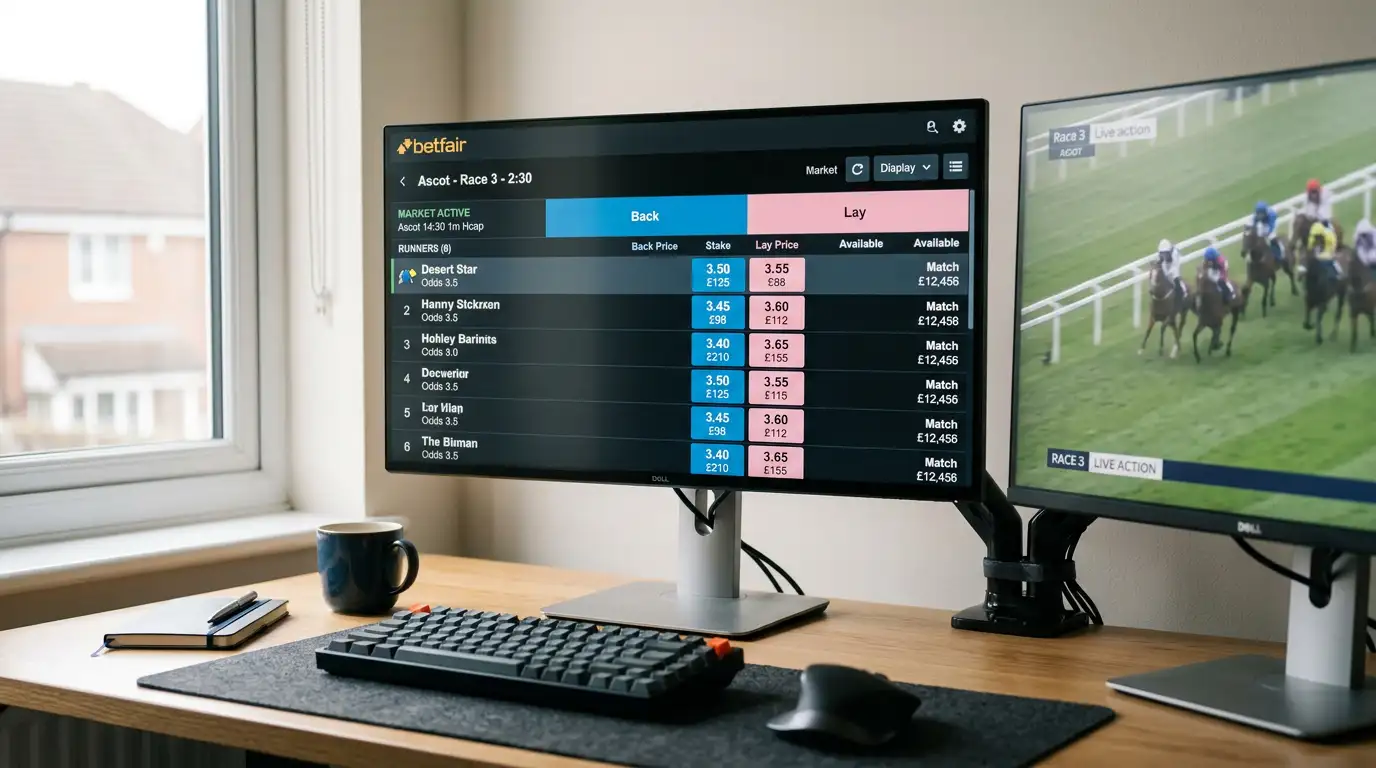
The interface shows three back prices and three lay prices for each runner, along with the amount of money available at each price. Back prices (in shades of blue) are the prices you can back at — buying the horse to win. Lay prices (in shades of pink) are the prices you can lay at — selling the horse, betting that it loses. The numbers next to each price show how much money is currently being offered. If you click into more depth, the full price ladder appears, showing every level of available prices and money.
UK horse racing is the second-largest segment of online betting in the country, contributing £766.7 million in remote gross gambling yield over the 2024-25 financial year. The exchange captures a meaningful share of that volume, and the liquidity on big Saturday meetings is genuinely deep. Midweek midday cards can be thinner — sometimes much thinner — and the same horse that trades smoothly at hundreds of pounds at Royal Ascot might be a tricky market at fifty pounds on a Thursday at Lingfield. Knowing your liquidity environment matters before you place any bet.
Prices move when bets are matched. As money flows into a horse — punters wanting to back it — the back price typically shortens because fewer people want to lay at the higher number. As money flows out, the price drifts. The market is responsive to news, weather changes, and the steady drumbeat of professional opinion that filters into the prices in the hours before a race. Reading those movements is part of the skill of using the exchange well.
Back and lay mechanics
Backing a horse on the exchange works essentially like a conventional win bet, with the price quoted in decimal odds instead of fractional. A bet of £10 to back at 5.0 returns £40 profit if the horse wins (50 total payout minus your 10 stake). The only operational difference is that you sometimes have to wait briefly for the bet to match if you’ve specified a price slightly better than what’s currently available — and the exchange charges commission on your net profit if you win.
Laying is genuinely different and is the feature the exchange exists for. When you lay a horse, you’re betting against it — taking on the role the bookmaker plays in a traditional bet. If I lay a horse at 5.0 for £10, I receive £10 from the matching backer immediately. If the horse loses, I keep that £10. If the horse wins, I have to pay out £40 — the £10 stake the backer put on, multiplied by the 4.0 net profit they’re entitled to at 5.0. My maximum potential loss is the £40 (called the “liability”), not the £10 stake.
The liability calculation catches new exchange users every time. The stake on a lay bet is what you stand to gain; the liability is what you stand to lose. They’re not the same number except when the price is exactly 2.0. At higher prices, the liability is much larger than the stake. At a lay price of 10.0, a £10 lay carries a £90 liability. Sizing lay bets to a sensible fraction of your bankroll requires thinking in liability terms, not stake terms.
The general principle that’s worth holding in your head: laying short prices means small returns and small liabilities; laying long prices means small returns and large liabilities. A £10 lay at 2.0 risks £10. The same £10 lay at 20.0 risks £190. The maths is straightforward but the consequences of forgetting it can be painful.
For an even more specialised use of the back-and-lay mechanics — trading pre-race prices to lock in profit before the off — see my article on back-to-lay trading. The principles set out here are the foundation for that more active style of exchange use.
Commission structure
Betfair charges commission on net winnings in each market, not on individual bets. The standard commission rate for new UK accounts is typically 5%, though this varies by jurisdiction and by certain customer-specific factors. If your net winnings across all your bets in a particular race come to £100, you pay £5 in commission and receive £95.
The “net winnings in each market” calculation is the part that matters. Commission applies only when you’ve made money on the race overall. If you backed one horse and laid another, and the result of the race left you up £80 from one transaction and down £30 from the other, the net is £50 — and that £50 is what gets charged commission. Commission does not apply to gross winnings on bets; it applies to the bottom line for each market.
The implication is that hedged positions, where you’ve taken multiple bets across the same race to lock in profit, are charged commission only on the resulting net. This is part of why back-to-lay traders can operate profitably despite very thin margins per trade — the commission is being paid only on the net result rather than on each gross transaction.
Operationally, commission is deducted automatically when markets settle. You don’t pay it separately. The account shows your winnings net of commission, and the rate applied is whatever your account is configured at. Some long-term users with high turnover have negotiated different rates, and there are occasional promotional periods where the rate is reduced temporarily, but the standard rate is what most users will encounter.
One detail that occasionally trips up newer users: commission compounds slightly with prices because high-priced winners produce larger gross returns. A 10/1 winner (10.0 decimal) at a £10 stake produces £90 profit, which gets charged commission down to £85.50. A 2/1 winner (3.0 decimal) at the same £10 stake produces £20 profit, charged down to £19. The cumulative effect of commission is more noticeable on long-priced winners — though the absolute returns are still larger.
Liquidity and market depth
Liquidity is the amount of money available to match against your bets. A market with deep liquidity has large sums available at every price level; thin markets have small sums available at only a few prices. The practical implication is that thin markets can’t absorb large stakes without moving the price against you.
UK racing markets vary enormously in depth. Saturday afternoon races at major meetings — Cheltenham Festival, Royal Ascot, the Grand National — have markets that can absorb thousands of pounds in stakes without meaningful price movement. Midweek evening cards at all-weather venues might have markets where a £100 bet visibly moves the price. Knowing which environment you’re trading in matters when sizing bets.
The price ladder shows you exactly how much money is available at each price level. If a horse shows £200 at 5.0 in the back column and £50 at 4.9, you can back at 5.0 to a total of £200 without the price shifting, but you can only back £50 at 4.9 before the next price level (perhaps 4.8) takes over. Reading the ladder before placing a bet tells you what’s actually achievable at the displayed prices.
Liquidity also varies through the race-day cycle. Markets are typically thinnest in the early morning, fatten up through the afternoon as race time approaches, and reach maximum depth in the final fifteen minutes before the off. Late market betting offers the best liquidity but also the most rapid price movement, as the cumulative weight of pre-race opinion crystallises in those final minutes.
For larger structural context on how prices are formed and how exchange pricing differs from sportsbook pricing, my piece on horse racing odds and market structure covers the comparison in detail.
The mental shift the exchange requires
Coming from sportsbook betting to the exchange, the biggest mental shift is accepting that prices reflect collective opinion rather than the operator’s view. A sportsbook price is one entity’s assessment, often modelled and margined. An exchange price is the equilibrium where backers and layers are willing to transact. The two produce different numbers for different reasons.
The exchange price is, for most punters, a better number to work with. The margin is smaller (essentially the commission rather than the 5–20% overround embedded in sportsbook prices), the pricing tends to be sharper because it reflects active competition between informed traders, and the access to lay betting opens strategies that sportsbooks don’t permit. The trade-off is that exchanges require more attention to the mechanics — bet matching, liquidity, commission calculation — than the relatively simple act of clicking a sportsbook bet slip.
Most serious UK racing punters end up with exchange accounts as their primary betting platform, supplemented by sportsbook accounts for specific situations (Best Odds Guaranteed promotions, certain ante-post markets where sportsbooks offer better terms). Starting with the exchange as the foundation, rather than as an afterthought, is the choice that pays back over time. The first week of learning the interface and the commission maths is genuinely a small price for what comes after.
How is Betfair commission calculated on a winning bet?
Commission applies only to net winnings in each market, not to individual bets or gross returns. If your net result on a particular race is £100 profit, you pay 5% (the standard rate) and receive £95. If you’ve hedged across multiple bets in the same race, commission is calculated on the resulting net rather than on each gross transaction. Commission is deducted automatically when the market settles.
Why are exchange odds often higher than bookmaker odds?
Sportsbook prices include the bookmaker’s margin (typically 5–20% across a race), built into every price. Exchange prices reflect the equilibrium between backers and layers competing to match each other, with the exchange operator collecting commission only on net winnings. The margin charged by the exchange is effectively just the commission rate (around 5%), which is consistently less than the sportsbook overround on most races.
What is market liquidity and why does it matter for UK racing?
Liquidity is the amount of money available to match against your bets at each price level. Deep markets can absorb large stakes without the price moving; thin markets can’t. Saturday racing at major meetings has deep liquidity; midweek midday cards can be thin. The practical implication is that bets in thin markets can move the price against you as they match, making the effective price worse than the displayed price.
Published by the Betting Strategy for Horse Racing team.