Back-to-Lay Trading Systems
 Available in US
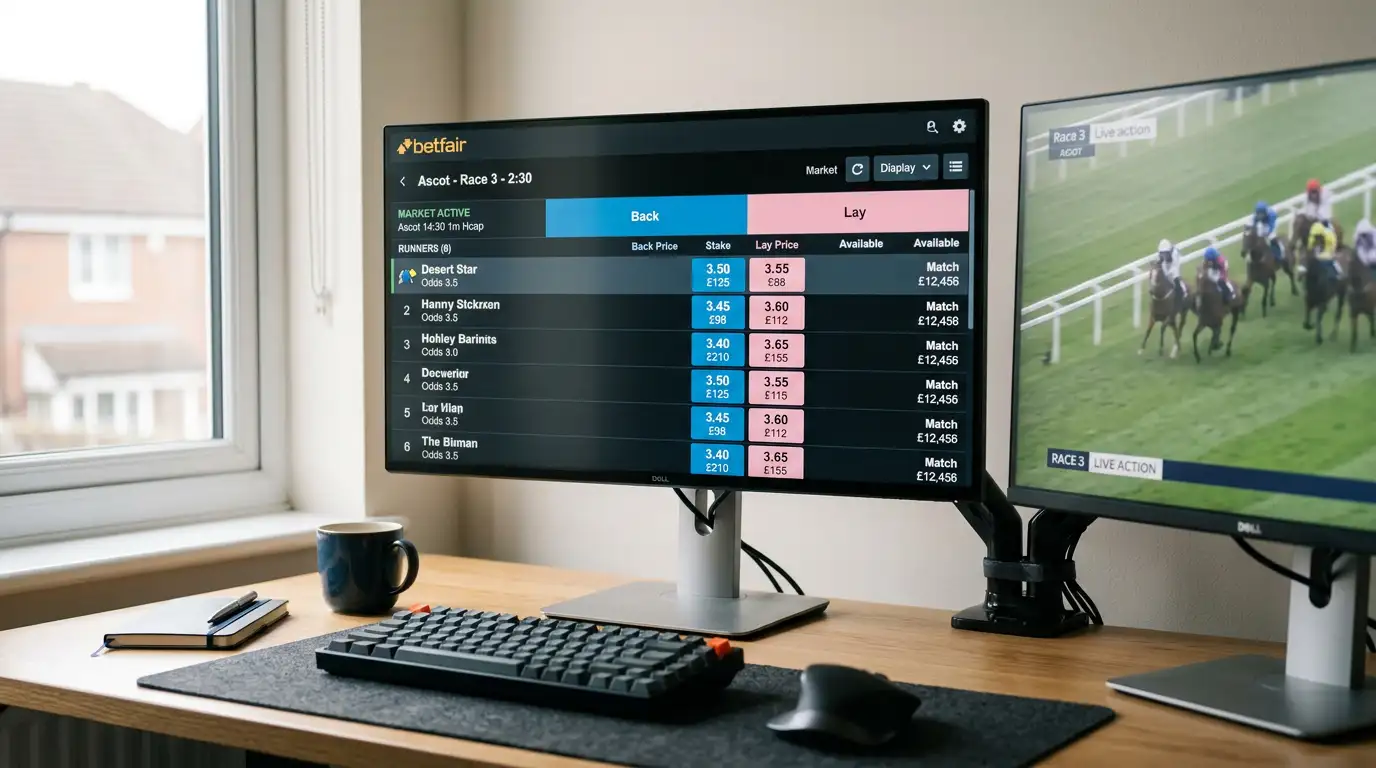
The first time I closed a back-to-lay position and walked away from the race before it had even started, I felt slightly fraudulent. The horse I’d backed went on to finish fifth. My account, however, had already booked a tidy profit on it twenty minutes earlier. Nothing in conventional betting wisdom prepared me for that disconnection between outcome and result.
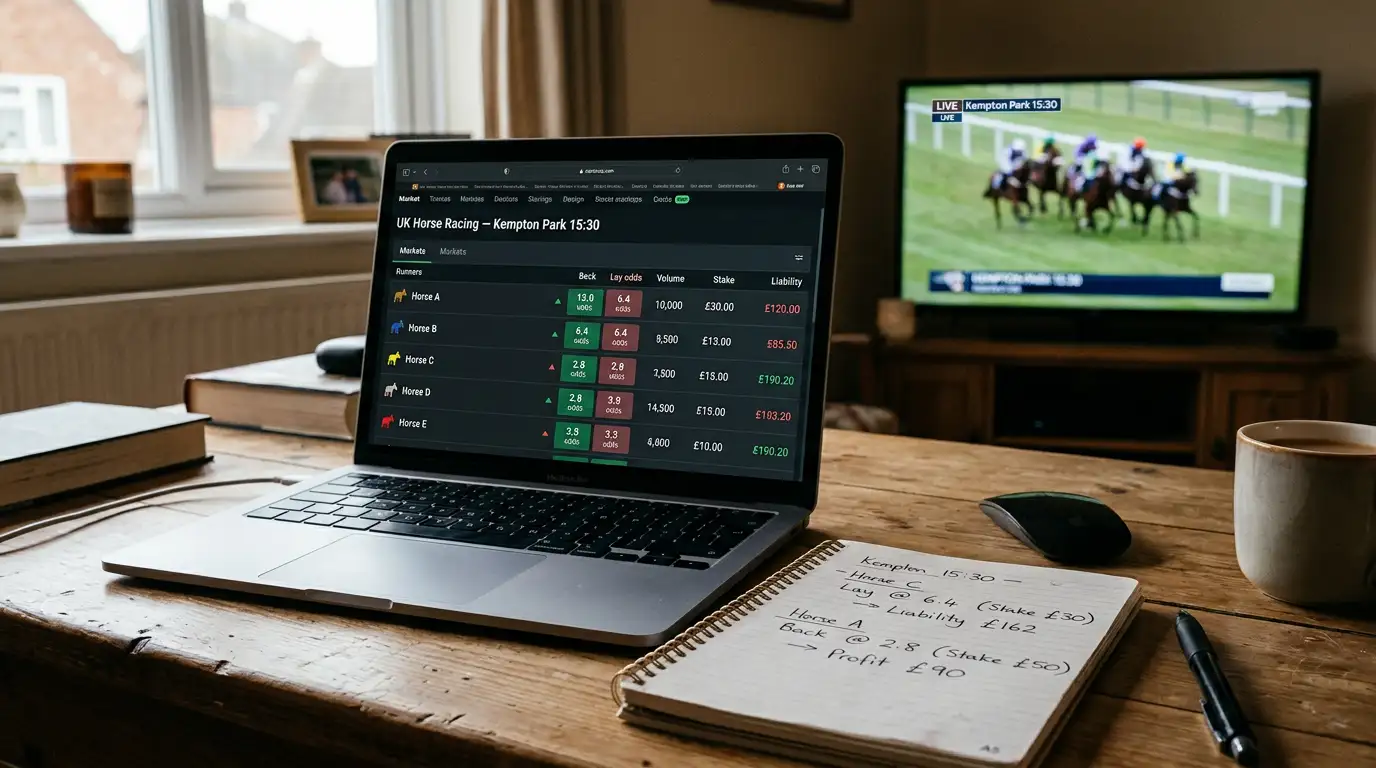
Back-to-lay trading is, at its core, an exchange technique that bets on the direction of the price rather than the outcome of the race. You back a horse early, hope the market shortens that price, then lay the same horse at the shorter price for a calculated stake that locks in profit no matter who actually wins. The race itself becomes irrelevant. What matters is the gap between the price you bought at and the price you sold at.
Exchange Trading Mechanics and Green Up
I’ll walk through this with a concrete example because the maths is the only part that matters and the maths is straightforward once you see it laid out.
Imagine you back a horse at decimal odds of 6.0 for £20. Your potential winnings if the horse wins are £100 (£20 stake times 5.0 net profit). Then, twenty minutes before the off, the price has shortened to 4.0. You decide to lay the same horse — bet against it — at 4.0 for £30. If the horse wins, you collect £100 from the back bet and pay out £90 on the lay (£30 stake times 3.0 net loss). You net £10. If the horse loses, you lose the £20 back stake but keep the £30 lay stake. You net £10 again. Either way, £10 is yours. The race becomes a formality.
The lay stake to lock in equal profit on both outcomes is calculated by the formula lay stake equals back stake multiplied by back price, divided by lay price. In the example above: 20 multiplied by 6.0, divided by 4.0, equals 30. That gives you the perfectly hedged position. Punters call this “greening up” because Betfair’s interface shows green numbers across all outcomes when a position is fully hedged.
You don’t have to hedge perfectly. You can weight more profit onto the back side if you still fancy the horse to win, or more onto the lay side if you’ve changed your mind. The choice is yours. The clean version is the all-green hedge that takes the race out of play entirely.
Spotting horses whose price is likely to shorten
This is where the work lives. Anyone can compute a hedging stake. Fewer people can predict which horses will be supported in the run-up to the off. Without that ability, you’re just gambling on price direction blindly, and the exchange’s commission will eat you alive.
The classic shorteners are well-known trainer-stable runners receiving late support, particularly from yards that don’t make many entries. When a “small yard, big day” horse appears on a card with notable money following it, the market often moves into it as race-day analysis catches up. Newspapers and tipping services pushing a horse can move shorter prices visibly, especially on smaller races where liquidity is thinner.
Course specialists at courses with strong local followings, horses dropping in class, and horses whose form lines have been reassessed after a recent winner pulled clear are all candidates for late support. There’s no magic formula here — it’s pattern recognition built on watching markets for months. The signals are subtle, and you’ll get it wrong as often as you get it right when you start.
Liquidity matters too. UK horseracing was the second-biggest segment of online betting in 2024-25, generating £766.7 million in remote gross gambling yield, which sounds like a lot until you remember that’s spread across more than ten thousand races. Big Saturday meetings have deep markets that move smoothly. Midweek midday cards have thin markets that jump on small bets. You want enough liquidity that your own stakes don’t move the price you’re trying to read.
A worked trade, start to finish
Let’s go through a real-looking trade. It’s mid-afternoon on a Tuesday, and I’ve identified a horse in a six-runner novice hurdle that I think is being underestimated by the market. The horse’s price opened at 5.0 and has crept out to 5.5 with no particular news. My read is that the price will move back in once tipsters publish their afternoon selections and the regular Twitter racing crowd starts pointing at it.
I back £40 at 5.5. My liability if I do nothing is the £40 stake; my potential return if the horse wins is £180 (£40 times 4.5). Two hours later the price has indeed moved — to 3.8. I now have to decide whether to take profit or let it run.
If I lay £40 multiplied by 5.5, divided by 3.8 — that’s £57.89 — at 3.8, both outcomes pay me roughly £20. I’ve made a fifty percent return on my original stake in a couple of hours, and the actual race is now irrelevant. Or I can take a slightly different stake to bias outcomes: laying £50 leaves me with £30 profit if the horse wins and £10 profit if it loses, which is a perfectly defensible split if I still rate the horse highly.
The discipline is to take the profit when it appears. Holding for further shortening is the trap that catches most beginners. Prices move in both directions, and the horse you backed at 5.5 and that briefly touched 3.8 can drift back to 5.0 just as easily. Once you’ve identified a profitable exit, take it.
Greening up — what it actually means
“Greening up” is exchange slang for fully hedging a position so that every outcome shows a positive return on your screen. The colour comes from Betfair’s interface convention, where the profit-and-loss figures next to each runner go green for positive numbers. When you’ve greened up on a trade, the race result is neutralised: you win the same small amount whether the horse wins, places, or pulls up at the first.
The mechanical side of greening up is just the formula I gave above, distributed across whichever runners you’ve taken positions on. The interesting question is when to green up versus when to hold a directional position. My rule of thumb: green up whenever the market has given you the move you were predicting and your conviction has nothing further to add. Hold a directional position only when you have a specific reason to think the move will continue.
Trading software designed for the exchange — ladder interfaces, one-click hedging buttons, automated take-profit triggers — makes the mechanical side trivially fast. The ladder shows the prices as columns of available money, and you click to back or lay at specific prices. I cover the practical side of that software stack in my article on Betfair trading software for horse racing.
Risks that aren’t obvious until they bite
The risk that catches new traders first is execution speed. Prices move quickly in the last few minutes before a race, and a position you can hedge cleanly at three minutes to off can become unhedgeable at thirty seconds to off. If the market goes against you and there’s no opposing money available at any price near your entry, you’re stuck with the unhedged back bet and the race result decides your outcome. That’s not back-to-lay trading anymore; that’s straight betting with extra steps.
The second risk is commission. Betfair takes a percentage of net winnings on each market, and that percentage compounds across many trades. A trader scratching twenty trades a day for tiny green profits can find that commission eats most of the gains. Per-trade margins need to be wide enough — or the trades infrequent enough — to leave meaningful net profit after the exchange has taken its cut.
The third risk is psychology. Locking in £10 profit on a horse that then wins at the original price feels emotionally lossy, even though the trade was the correct decision. Punters who can’t shake that “I should have held on” feeling often abandon the hedging discipline mid-trade and end up running directional positions through races they didn’t intend to gamble on. Discipline matters more than analytical skill in this kind of trading.
The fourth risk is over-confidence. Anyone can make money for a week if the market happens to move their way. Sustained back-to-lay profitability over hundreds of trades is much harder. The best traders I’ve watched are slow, selective, and willing to skip days where the markets aren’t giving them what they need.
Whether this is for you
Back-to-lay trading is a niche within a niche. It demands an exchange account, access to liquid markets, time to watch prices in the run-up to races, and the temperament to take small profits cleanly. It’s not a beginner activity. Newcomers should spend a few months betting on the exchange in the conventional way — backing and laying based on race outcomes — before adding the time-shifted complexity of trading the price itself.
If you’ve got that foundation and the temperament fits, back-to-lay can be a quiet, low-variance source of returns on top of conventional betting. The discipline of leaving races neutralised, the satisfaction of identifying a price move correctly, and the relief of not caring who actually wins all combine into something distinctive. It’s a different game from picking winners. For some punters, it turns out to suit them far better.
How do I spot a horse whose price is likely to shorten?
Look for runners likely to attract late support: small-yard runners with serious entries, horses receiving tipster attention, course specialists at well-followed venues, and horses whose recent form has just been validated by another runner from the same line scoring a notable win. The skill is built on watching markets daily for months — there’s no shortcut. Liquidity matters too: thin midweek markets move on small bets, while Saturday markets need bigger drivers.
What does ‘greening up’ mean in back-to-lay trading?
Greening up is fully hedging a position so every possible outcome shows a positive return. The name comes from Betfair’s interface, which displays profit figures in green when they’re positive. After greening up, the race result is neutralised — you collect the same small profit whether your horse wins, places or finishes nowhere. The mechanical step is calculating the lay stake that balances the position; software does it in one click.
Is back-to-lay profitable with small bankrolls?
It can work with small bankrolls, but commission and trade selection matter more proportionally. With limited capital you can’t trade every signal, so each trade needs to be a stronger setup. The exchange commission also takes a bigger relative bite when stakes are small. A realistic small-bankroll approach is to pick one or two highly liquid Saturday handicaps a week, look for clear shorteners, and accept very few trades in exchange for higher-quality setups.
Published by the Betting Strategy for Horse Racing team.