A Practical Glossary of UK Horse Racing Betting Terms
 Available in US
There’s a moment in every new racing punter’s experience when they realise the conversation in the betting shop or on Racing TV isn’t actually English. The words are English, but they’ve been pressed into service for purposes the dictionary doesn’t quite cover. A “drifter” isn’t someone wandering aimlessly; a “steamer” isn’t a boat; “BSP” isn’t a political party. The vocabulary of UK racing has accumulated over centuries of use, and learning it is genuinely the first task for any punter wanting to graduate from random clicking to informed betting.
This piece walks through the terms a UK racing punter actually encounters, organised by the situation in which they tend to appear rather than alphabetically. The point isn’t dictionary completeness — Racing Post and Timeform glossaries cover that — but practical orientation. When you hear these terms used in commentary, in form analysis, or in conversation with experienced punters, you should be able to follow what’s being discussed and contribute usefully to it.
The vocabulary of odds and prices
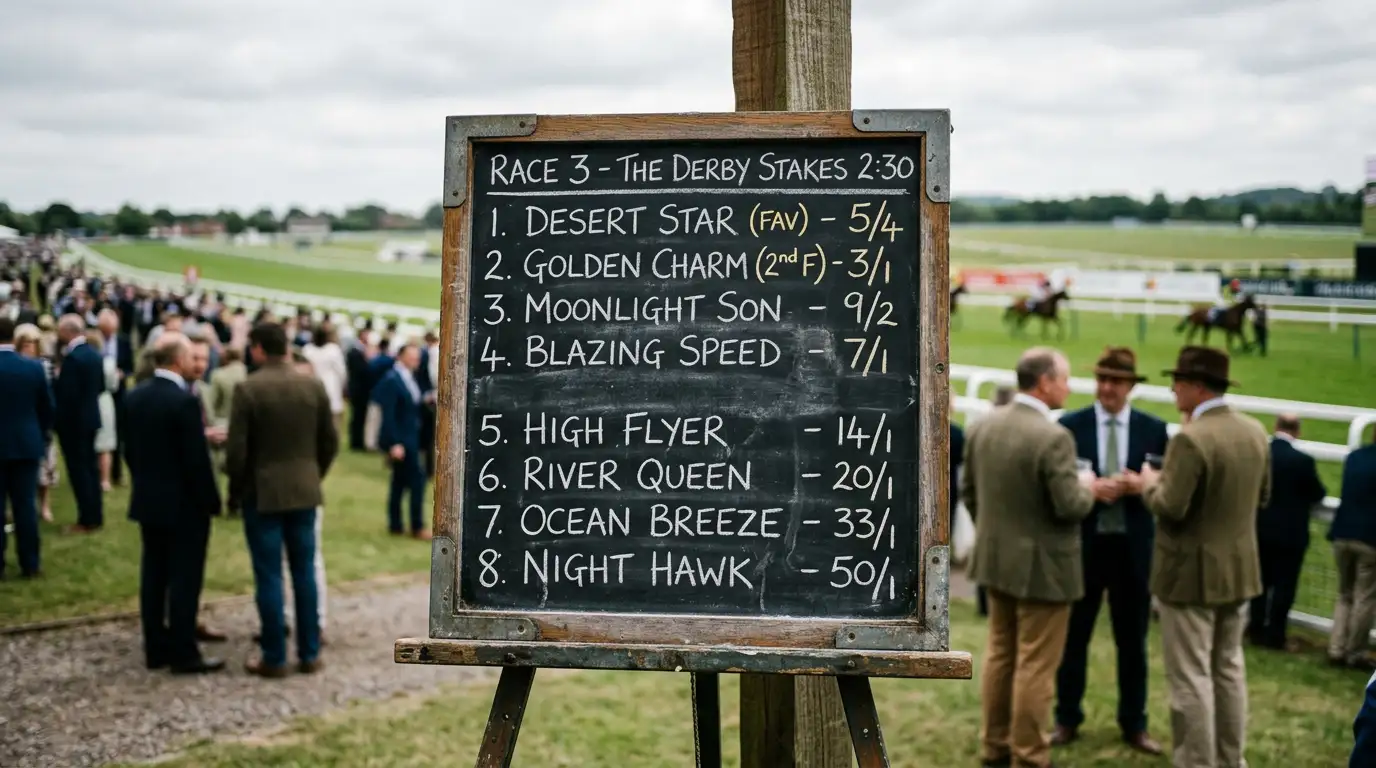
Odds are quoted in either fractional form (the British tradition, 5/1, 11/4, 9/2) or decimal form (the European and exchange standard, 6.0, 3.75, 5.5). The two represent the same probabilities; only the presentation differs. A fractional 5/1 means a £1 stake returns £5 profit plus the stake back; the decimal equivalent 6.0 means the £1 stake returns £6 in total. Most UK sportsbook displays still use fractional odds by default while the Betfair Exchange uses decimal.
The starting price, universally abbreviated SP, is the official price at which a horse goes off, calculated from the prices available across the major UK on-course bookmakers at the moment the race begins. SP is the reference price for many promotional structures, including Best Odds Guaranteed, and it’s the price most casual punters effectively bet at if they leave their bets to be matched at the off. Betfair Starting Price, or BSP, is the exchange equivalent — calculated separately from the SP and often producing meaningfully different numbers due to the different pricing mechanism.
A “drifter” is a horse whose price gets longer as the market reacts to information — usually negative information about the horse’s chances. A “steamer” is the opposite, a horse whose price shortens as money piles in. Both terms describe market behaviour rather than horse behaviour, and both are watched closely by punters who treat market signals as information. A horse drifting from 4/1 to 8/1 in the final hour is being marked down by the market for reasons that may or may not be public; a horse steaming from 8/1 to 4/1 is being marked up.
The “overround” is the cumulative bookmaker margin built into a race’s prices — the gap between the implied probabilities (which would total 100% if the prices were fair) and the actual implied probabilities (which always total more, typically 105% to 120% in UK racing). The overround is the structural reason sportsbook betting carries a long-run disadvantage; understanding it is essential for any analytical approach. The exchange equivalent is the commission rate, typically 5%, which is substantially smaller than typical sportsbook overrounds. For the full structural treatment of how prices are formed and what the overround actually means in practice, see my piece on horse racing odds and market structure.
A “value bet” is a bet where the available price overstates the true probability of the outcome. The concept is theoretical — you can never know the true probability with certainty — but the principle of looking for prices where the value is favourable is what distinguishes analytical betting from random selection. The underlying mathematics is the same as any expected-value calculation: probability times return must exceed stake for the bet to have positive expected value.
Bet types and structures
A “win” bet pays out only if the selection finishes first. A “place” bet pays out if the selection finishes in the predetermined place positions for the race (typically first three or four, depending on field size and operator). An “each-way” bet combines both — half the stake on win and half on place — and is one of the most common UK racing bet structures. The terms vary by field size: five-runner races usually pay each-way on the first two; six- to seven-runner handicaps on the first three at one-fifth the odds; eight-plus runner handicaps on the first three at one-quarter; sixteen-plus runner handicaps on the first four at one-quarter.
An “accumulator” combines multiple selections into a single bet that pays only if all selections win. Variants include the “double” (two selections), “treble” (three), and named combinations like the “Yankee” (four selections producing eleven bets), the “Lucky 15” (similar plus the four singles), and the “Trixie” (three selections producing four bets).
The “Tote” is the UK pari-mutuel betting pool — a system where all stakes are pooled and dividends are calculated after the race based on the pool size and the winning selections. Pool structures include Tote Win, Tote Place, Exacta (first two in correct order), Trifecta (first three), and Placepot (placing a horse in each of the first six races).
“Ante-post” betting is wagering placed in advance of the race. The prices are typically more generous than the day-of-race market, but stakes are usually lost if the selected horse doesn’t run. “Non-runner no bet” (NRNB) terms refund stakes on non-runners. “In-play” or “in-running” betting is wagering placed while a race is actually in progress, with prices updating in real time as the race unfolds.
The form and racecard vocabulary
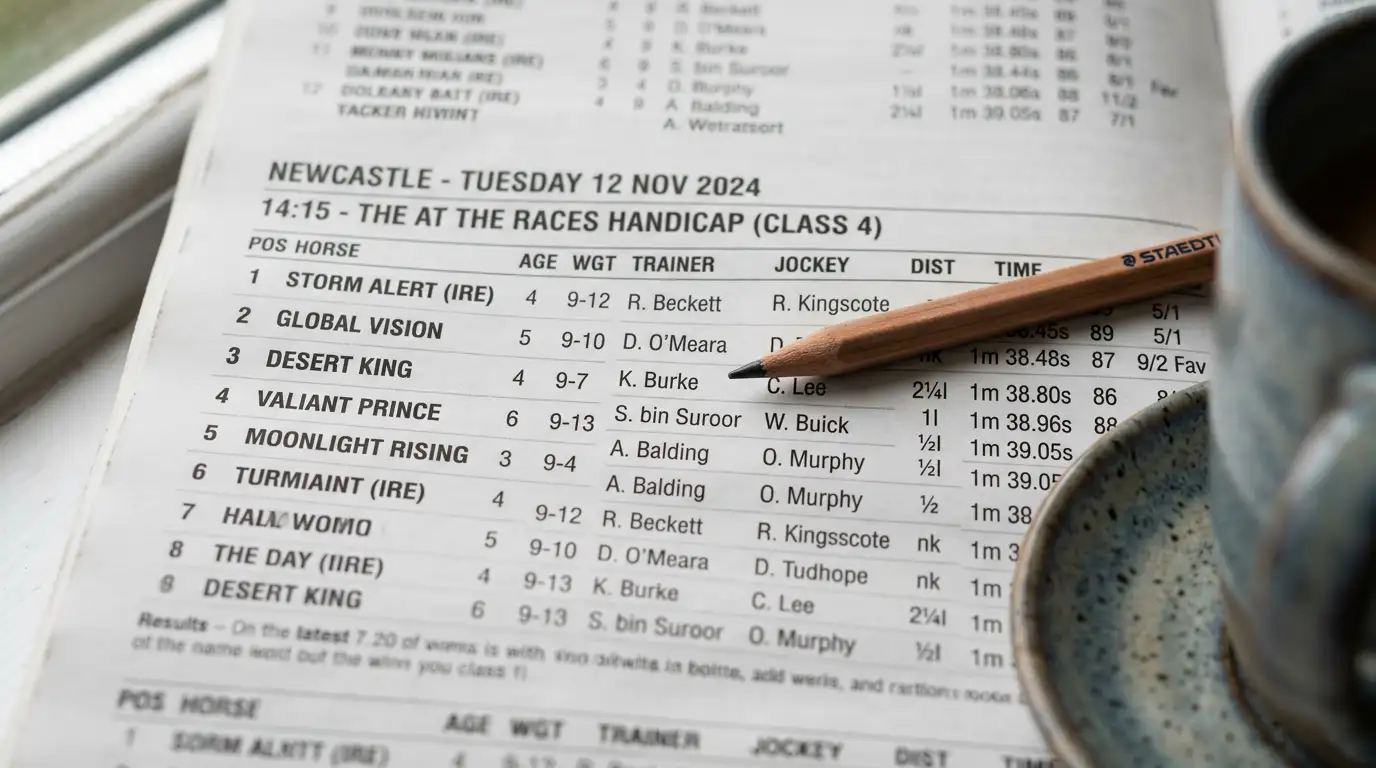
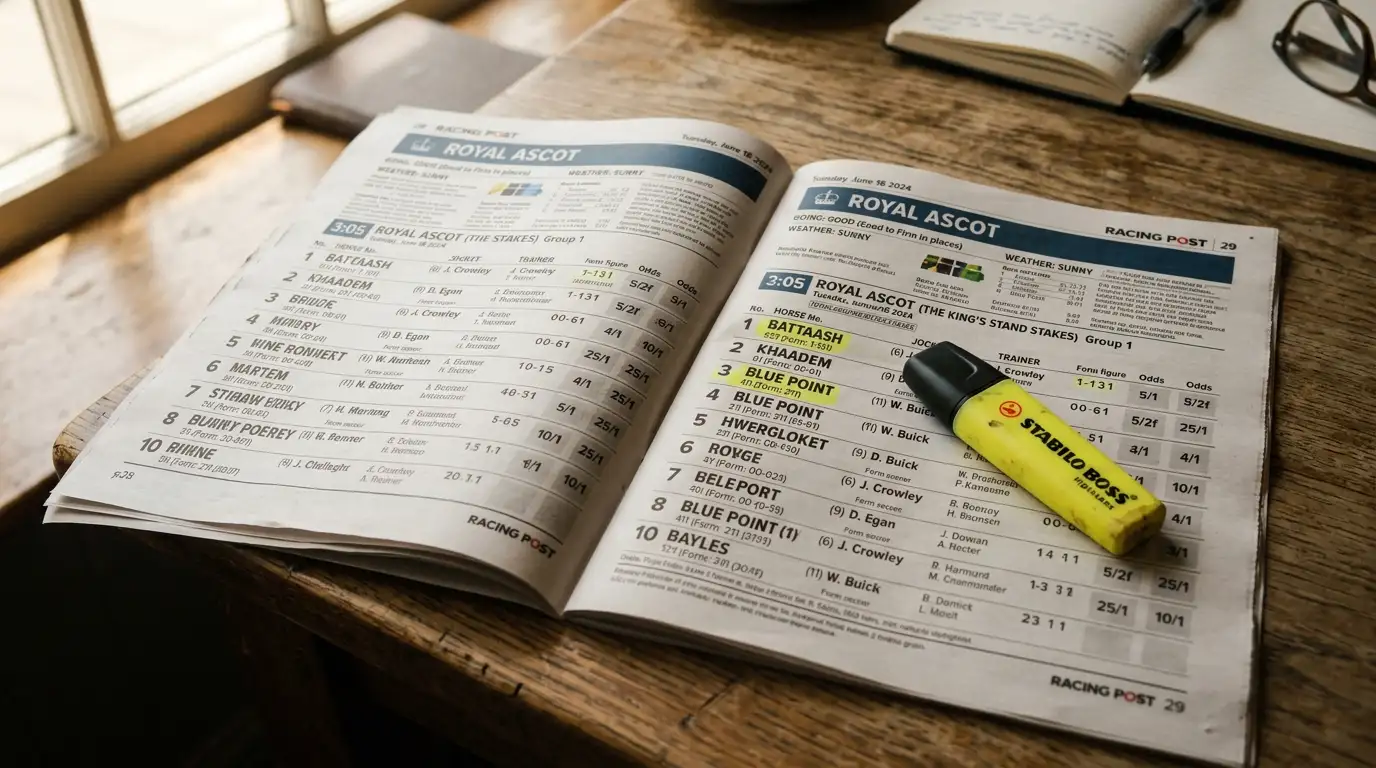
The “form figures” against each horse’s name on a racecard summarise recent finishing positions. The figures read right-to-left from the most recent run, with numerals indicating finishing positions and letters indicating non-completions: F for fall, P or PU for pulled up, U for unseated rider, R for refused, BD for brought down. The hyphen indicates a season break.
“OR” is Official Rating — the BHA handicapper’s assessment of a horse’s ability, used to determine handicap weights. “TS” (Topspeed) and “RPR” (Racing Post Rating) are alternative assessments published by the Racing Post, with Topspeed based purely on time and RPR incorporating subjective performance judgement. “TFR” or “Timeform Rating” is the equivalent from Timeform.
The “CD” marker indicates a previous course-and-distance win — a meaningful signal of horse-to-track compatibility. Separate “C” or “D” markers indicate course-only or distance-only wins. “BF” stands for “beaten favourite” and indicates the horse was an unsuccessful favourite in a previous race.
The “going” is the official description of the track surface condition, ranging through hard, firm, good-to-firm, good, good-to-soft, soft, and heavy on turf. All-weather courses use a separate scale (standard, standard-to-slow, standard-to-fast). The “stalls” or “draw” is the starting position on flat races, allocated by random ballot before the race.
Race types and class structure
A “handicap” is a race in which horses carry different weights based on their official ratings, designed to give every runner a theoretically equal chance. Handicaps are the most numerous race type in UK racing. “Conditions” races use age and sex weight allocations without handicap adjustment; “maidens” are for horses who have never won; “novices” in jumps racing are for horses who haven’t won in their current discipline.
The “Pattern” is the elite tier of flat racing, structured into Group 1 (championship races), Group 2, Group 3, and Listed races. In jumps racing, the equivalent uses Grade 1, Grade 2, Grade 3, and Listed designations. Pattern and Graded races are deliberately structured so weight allocations reflect age, sex and experience rather than ability.
A “selling race” is one where the winner can be purchased at auction immediately after. A “claimer” is similar but allows owners of running horses to claim rivals for predetermined prices. “Bumper” races (officially National Hunt Flat races) are flat races contested by horses being prepared for jumping careers. A “small field” typically means seven or fewer runners; a “large field” usually twelve or more.
The trader and exchange vocabulary
“Back” a horse means to bet on it to win — the conventional bet direction. “Lay” a horse means to bet against it, taking the bookmaker’s role in the transaction. Lay betting is available on betting exchanges and is one of the structural features distinguishing exchanges from traditional sportsbooks.
“Liability” is the amount you stand to lose on a lay bet, typically much larger than the stake. A £10 lay at 5.0 carries a £40 liability. Confusing stake and liability is a common error among new exchange users.
“Hedging” means placing an additional bet to lock in profit or limit loss on a position you’ve already taken. “Scratching” a position means closing it before the race runs, typically when conditions have moved against the original analysis. “Liquidity” is the amount of money available to match against your bets at each price level — deep markets can absorb large stakes without price movement; thin markets can’t.
The operational and regulatory vocabulary
“Gubbing” or “restriction” is bookmaker action limiting a customer’s account — reduced stake caps, removed promotional access, or in some cases outright account closure. The practice is legal under UK sportsbook terms and is the standard response to customers identified as systematic winners. Restricted accounts often retain some functionality but lose the structural advantages that made the operator commercially useful.
“BOG-restricted” is a specific subcategory — accounts that have lost access to Best Odds Guaranteed protection while remaining nominally open. Once an account is BOG-restricted, the long-term value of using that operator has substantially diminished, even if stake caps haven’t yet been imposed.
“Affordability checks” are the UK Gambling Commission regulatory requirement for operators to assess customer financial vulnerability when deposit thresholds are crossed. The current thresholds are £150 monthly net deposits for the light-touch background check, with potential enhanced checks if flags appear. The framework was introduced in stages through 2024 and 2025 and has reshaped the practical experience of UK betting.
The “levy” — formally the Horserace Betting Levy — is the statutory contribution bookmakers make to UK racing’s central funding mechanism, distributed through the Horserace Betting Levy Board (HBLB). The 2024-25 levy reached a record £108.9 million, funding prize money, regulation, and veterinary research. The levy is the structural connection between betting activity and the financial sustainability of UK racing itself.
The terms that aren’t really terms
Some of the most-used phrases in UK racing aren’t technical terms but figures of speech that nevertheless carry specific meaning. “Going off shorter” means the horse’s price was bet down before the race; “going off bigger” means the opposite. “Up in the weights” means carrying more weight than previously, usually because the horse has been raised in the handicap. “Wrong side of the draw” means drawn in a position the course’s bias works against.
“The book is wrong” is the analytical punter’s phrase for finding value — believing the bookmaker’s prices misjudge the true probabilities. “Falling out of the air” describes a horse whose price suddenly collapses just before the off.
The vocabulary keeps developing. Each generation of UK racing punters adds new terms and retires old ones, but the core lexicon has been remarkably stable for decades. Punters who learn it can communicate efficiently with the broader racing community, follow commentary intelligently, and read form analysis with confidence.
What does BSP mean and why is it different from SP?
BSP is the Betfair Starting Price — the official exchange price calculated from the volume of back and lay bets matched in the final moments before the race begins. SP is the bookmaker Starting Price, calculated separately from the prices available across major UK on-course bookmakers. The two often differ because the exchange and the bookmaker market operate on different pricing mechanisms; the BSP frequently shows different (often longer) odds than the SP. Most promotional structures like Best Odds Guaranteed use SP rather than BSP as the reference.
What is the difference between a drifter and a steamer?
A drifter is a horse whose price gets longer as the market reacts — typically reflecting negative information about its chances. A steamer is the opposite, a horse whose price shortens as money piles in, usually indicating positive market signals or strong professional support. Both terms describe market behaviour and are watched closely by punters who treat the market itself as information. A horse drifting from 4/1 to 8/1 in the final hour is being marked down for reasons that may or may not be public; a horse steaming from 8/1 to 4/1 is being marked up.
What does ‘CD’ mean on a racecard?
CD stands for course and distance — indicating that the horse has won before at the specific combination of the course and the distance it’s contesting that day. The marker is meaningfully more informative than either course wins alone or distance wins alone, because it captures the precise conditions the horse has already proven it can handle. The strength of the signal depends on how many CD wins the marker reflects: one is suggestive, three or four is substantial evidence of genuine specialism.
Prepared by the Betting Strategy for Horse Racing editorial staff.