Betfair Trading Software for Horse Racing: Tools Beyond the Default Site
 Available in US
A trader I know used to bet on the Betfair website for two years before finally trying a ladder interface. After his first afternoon with proper software, he sent me a message that read, more or less: “I’ve been driving a car with one hand tied behind my back”. The Betfair web interface works perfectly well for occasional punting. For anyone actually trying to trade prices — back-to-lay, lay-to-back, in-running, scratching positions when the market turns — it’s the wrong tool. Trading software exists because the default web interface isn’t designed for the activity that serious exchange users actually want to do.
Betfair trading software overlays the exchange’s API with interfaces designed specifically for active price-trading. Ladder displays, one-click bet placement, automated profit-taking triggers, position management across multiple markets — these are the tools that turn the exchange from a betting site into a trading platform. The shift in capability is enormous, and once you’ve used proper software it’s genuinely hard to go back to the web interface for any active trading work.
The ladder interface and why it matters
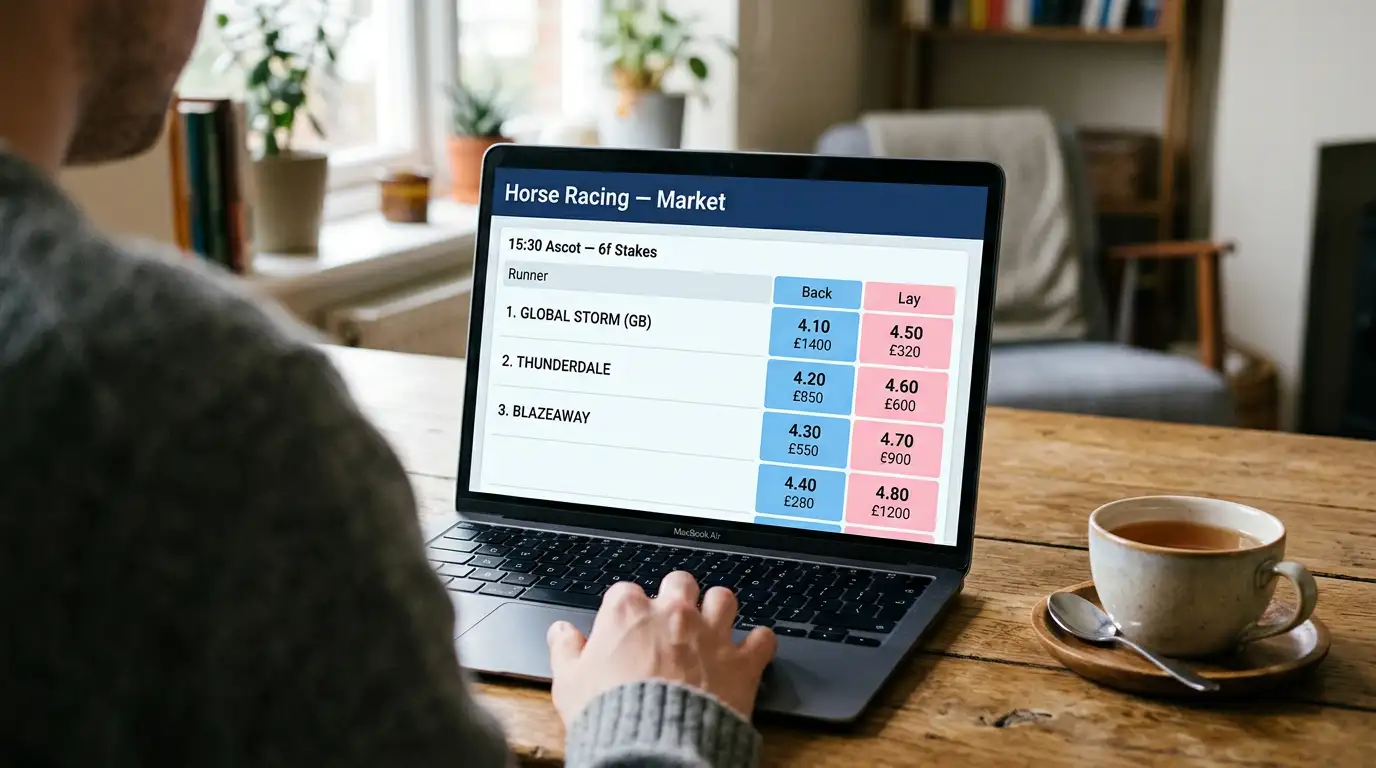
The standard Betfair web interface presents prices as a tidy list: three back prices, three lay prices, and the amounts available at each. It’s clean, beginner-friendly, and almost useless for active trading. The structure obscures what’s actually happening in the market, hides the deeper price levels, and forces you through multiple clicks to place each bet.
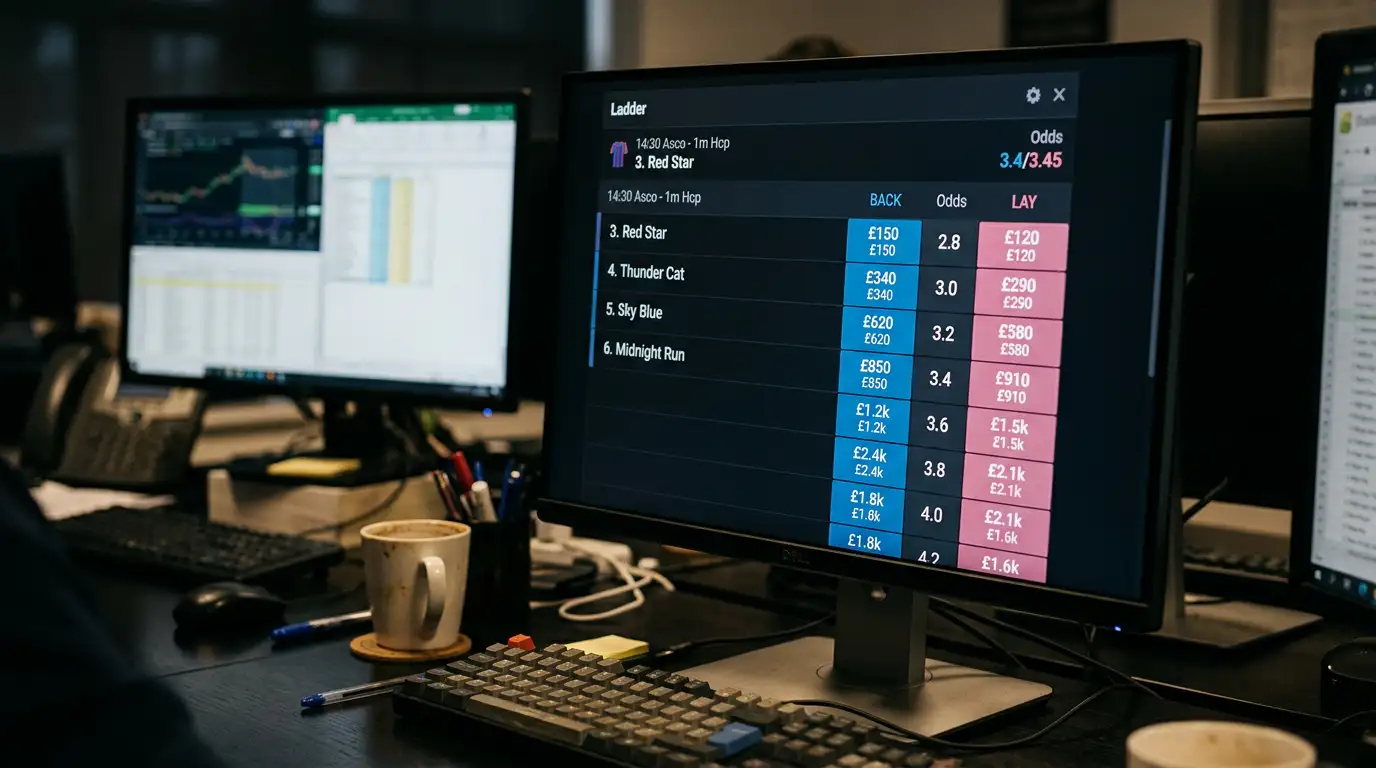
A ladder interface flips this completely. The screen shows a vertical column of prices, typically from short prices at the top to longer prices at the bottom, with the amount of money available at each price level displayed alongside. Back prices appear in one colour (typically blue), lay prices in another (typically pink). The trader sees the entire structure of the market at once: which prices have deep liquidity, which prices have only token money, where the market is currently trading, and where the next significant price levels sit.
The interaction is single-click. Clicking on a price level in the back column posts a back bet at that price for a pre-set stake; clicking in the lay column posts a lay bet. The bet appears in the market immediately, with no confirmation dialog and no slip-fill workflow. For traders managing multiple positions simultaneously, the speed difference compared with the web interface is the difference between catching a price move and missing it entirely.
The other dimension that ladders add is the price queue. Each price level shows not just the total money available but where in the queue your bet sits if you’ve placed an order. Knowing whether your bet is first in line or twentieth tells you how likely it is to match before the price moves. This level of detail is genuinely missing from the standard interface and is the kind of information that distinguishes informed trading from passive betting.
Popular UK trading platforms
Several established platforms have served the UK trading community for years. Bet Angel, developed by a small UK-based team, is one of the most widely used and offers a comprehensive feature set: ladder interfaces, automated trading scripts, market-monitoring tools, and integration with race-card data services. Geeks Toy, another UK product, takes a slightly different approach with a focus on clean ladder design and rapid execution. Both products have been continuously developed for over a decade and have substantial user communities.
Each platform has its own pricing model — typically a monthly subscription or one-time license fee — and its own specific feature set. Bet Angel is known for the depth of its automation features and its compatibility with structured trading systems. Geeks Toy is often preferred for its simplicity and execution speed by traders whose strategies don’t require complex automation. The right choice depends on what kind of trading you intend to do, and the practical answer is usually to trial both on demo accounts before committing.
The software accesses Betfair’s API to read prices and post bets in real time. This means the platforms operate on top of the standard exchange, with no separate marketplace or pricing — you’re trading on Betfair in either case, just through a different interface. The API integration also means that prices update in milliseconds rather than seconds, which matters considerably when the market is moving quickly in the run-up to a race.
For the underlying strategic approach to trading positions — the back-to-lay technique that the software is designed to support — see my piece on back-to-lay trading. The software enables the technique; the technique is what actually produces returns. Software without strategy is a faster way to lose money in real time.
Automation and rule-based scripts
The more sophisticated trading platforms support automated trading rules — scripts that execute pre-defined actions when specific market conditions are met. A rule might say “if the price on this horse drops to 4.0 or below, automatically place a lay bet of £20” or “if my back bet matches and the price subsequently rises by 10%, place a hedging lay bet to lock in profit”. The complexity available ranges from simple triggers to multi-condition decision trees.
The appeal of automation is consistency. Manual trading depends on the trader being attentive at exactly the right moment; automated rules execute without emotional interference, without distraction, and without the latency of human reaction time. For specific recurring patterns — particular kinds of price moves, particular types of races — automation can capture opportunities that manual trading would miss.
The limitations of automation are equally real. Markets aren’t always rational, and rules that worked historically can fail spectacularly when conditions change. A script written to scalp small price moves on liquid Saturday markets can lose serious money when run during thin midweek liquidity, where the same price moves can become trapped positions that can’t be exited. Backtesting rules against historical data helps but doesn’t fully insure against future market regime changes.
The other automation pitfall is overconfidence. A rule that’s been running profitably for a month can produce false confidence in its long-term sustainability. Markets adapt; what worked yesterday won’t necessarily work tomorrow. Serious automated traders monitor their rules continuously and adjust or shut them down when performance degrades — they don’t set rules running and walk away.
Bots and the line between automation and replacement
There’s a distinction between scripts that execute trades on triggers (with the trader making the strategic decisions) and “bots” that make decisions autonomously. The former are widely used and uncontroversial; the latter exist in a more ambiguous space. Betfair’s terms permit certain kinds of programmatic activity but prohibit others, and the boundary depends on the specifics of what the bot is doing.
For UK punters, the operational answer is that automated trading scripts running through approved platforms (like Bet Angel or Geeks Toy) are accepted Betfair use. Fully autonomous bots developed independently and connected directly to the API may or may not be acceptable depending on the operator’s view of their behaviour. The safe path is to use established commercial platforms whose API access is licensed and whose automation features have been deemed acceptable by Betfair.
The other consideration with full automation is legal and regulatory. UK gambling law treats betting as betting regardless of whether the bet was placed manually or programmatically. The same affordability checks, account restrictions, and regulatory requirements apply to automated activity as to manual activity. Some traders have learned this the hard way after assuming that programmatic trading sat outside the regulatory framework.
The risks of over-automating
The most damaging mistake in automated trading is letting a script run with stakes the trader couldn’t afford to lose if the rule fails. A script that has produced steady profits for three months can produce catastrophic losses in three hours if market conditions change unexpectedly. Manual traders watching a losing position eventually stop themselves; automated scripts continue executing the rule until either the rule’s stop conditions trigger or the account runs dry.
The discipline I’d press hardest is hard stop-losses on automated rules. Every script should have a maximum loss per market and a maximum daily loss across all markets, beyond which the script halts automatically. Without these limits, the worst-case scenario is genuinely the loss of the entire trading bankroll in a single session, and the worst-case scenario does occasionally happen.
The other operational risk is connectivity. If your internet connection drops while an automated rule is running, the script can’t execute hedging trades, can’t close positions, and can leave you exposed to outcomes that wouldn’t have happened with manual oversight. Professional traders use redundant internet connections, uninterruptible power supplies, and monitoring systems that alert them to connectivity issues. Home traders running expensive automation on consumer internet are accepting a risk they may not have fully thought through.
Hardware requirements matter too. Active trading benefits from multiple monitors to display ladders for several markets simultaneously, low-latency internet to minimise the gap between price changes and your ability to react, and a desktop machine (rather than a laptop) for reliability. Mobile trading on a phone or tablet is genuinely worse than desktop trading — the interface is more constrained, the execution speed is slower, and the multi-market visibility that desktop setups provide is impossible to replicate on a small screen.
Where software is and isn’t worth the investment
For active traders placing dozens or hundreds of bets per week, trading software pays for itself many times over in saved execution time, captured price moves, and avoided mistakes. The subscription cost is trivial relative to the volume being traded. The productivity uplift over the web interface is substantial.
For occasional punters placing a few bets a week, the software is overkill. The Betfair web interface is adequate for low-volume activity, and the investment in learning a ladder interface, configuring trading rules, and integrating data services doesn’t pay back at low volume. The honest answer for many punters is that they don’t need the software because they aren’t really trading — they’re betting, and the web interface handles betting well.
The intermediate case — punters who are starting to trade actively and trying to decide whether the software investment makes sense — is where the answer depends on commitment. If you’re going to trade seriously for a sustained period, the software is essential. If you’re going to dabble for a few months and probably stop, the software won’t transform your results meaningfully. The honest self-assessment is the one that matters here.
UK racing’s £766.7 million in remote gross gambling yield in 2024-25 reflects the substantial pool of activity that supports the exchange marketplace and, by extension, the trading software ecosystem. The market is deep enough that trading at meaningful scale is genuinely possible, and the software tools that have developed alongside it are mature enough that competent traders can equip themselves properly without spending unreasonable amounts on tools or infrastructure. The barrier to entry isn’t the cost of the tools; it’s the time required to learn to use them effectively and the capital required to trade at a scale where they make sense.
Do I need trading software to back-to-lay profitably?
For small-stakes occasional trades, no — the Betfair web interface is functional enough. For active trading at any meaningful frequency, yes. The execution speed, multi-market visibility, and one-click order placement of dedicated ladder software make a substantial difference when capturing price moves. The web interface forces multiple clicks for each bet and obscures the deeper market structure that traders need to read. Established platforms like Bet Angel and Geeks Toy offer trial periods that let you test whether the software adds value to your specific style.
Are automated horse racing bots legal under UK rules?
Automated trading scripts running through approved Betfair-compatible platforms are within acceptable use. Fully autonomous independent bots connecting directly to the API sit in a more ambiguous space depending on what they actually do. The safe path is to use established commercial platforms whose automation features are explicitly licensed for Betfair use. UK gambling law treats automated betting the same as manual betting — affordability checks, account restrictions, and regulatory requirements all apply equally to programmatic activity.
What hardware is needed for fast Betfair trading?
A desktop computer (rather than a laptop) with multiple monitors is the practical starting point for serious trading. Multiple screens let you display ladders for several markets simultaneously; low-latency wired internet minimises the gap between price changes and your ability to react. Mobile devices are genuinely worse for active trading — the interface is constrained and execution is slower. Professional setups include redundant internet connections and uninterruptible power supplies, but home traders can start with a competent desktop and decent broadband.
Prepared by the Betting Strategy for Horse Racing editorial staff.